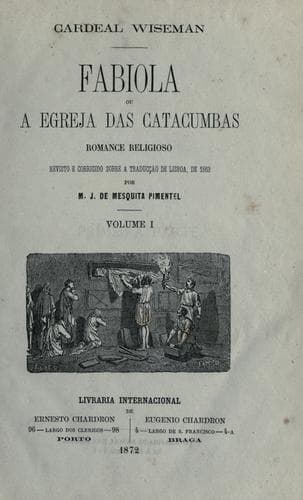
Fabiola; Or, The Church of the CatacombsWiseman, Nicholas Patrick
HistoryHistory
Fabiola; Or, The Church of the Catacombs
Wiseman, Nicholas Patrick
Christian fiction; Church history -- Primitive and early church, ca. 30-600 -- Fiction; Historical fiction
world,--she was selfish, light, and forward. The other, who was the
younger, was a perfect contrast to her,--so gentle, docile and
affectionate; so considerate about others; so devoted to her mother; so
kind and attentive to the poor patient. Irene herself was a type of the
Christian matron, in the middle class of life. Fabiola did not find her
intelligent, or learned, or witty, or highly polished; but she saw her
always calm, active, sensible, and honest. Then she was clearly
warm-hearted, generous, deeply affectionate, and sweetly patient. The
pagan lady had never seen such a household,--so simple, frugal, and
orderly. Nothing disturbed it, except the character of the elder sister.
In a few days it was ascertained that the daily visitor was not a
Christian; but this caused no change in their treatment of her. Then she
in her turn made a discovery which mortified her--that the elder
daughter was still heathen. All that she saw made a favorable impression
on her, and softened the hard crust of prejudice on her mind. For the
present, however, her thoughts were all absorbed in Sebastian, whose
recovery was slow. She formed plans with Irene for carrying him off to
her Campanian villa, where she would have leisure to confer with him on
religion. An insuperable obstacle, however, rose to this project.
We will not attempt to lead our reader into the feelings of Sebastian.
To have yearned after martyrdom, to have prayed for it, to have suffered
all its pangs, to have died in it as far as human consciousness went, to
have lost sight of this world, and now to awaken in it again, no martyr,
but an ordinary wayfaring man on probation, who might yet lose
salvation,--was surely a greater trial than martyrdom itself. It was to
be like a man who, in the midst of a stormy night, should try to cross
an angry river, or tempestuous arm of the sea, and, after struggling for
hours, and having his skiff twirled round and round and all but upset,
should find himself relanded on the same side as he started from. Or,
it was like St. Paul sent back to earth and to Satan’s buffets, after
having heard the mysterious words which only one Intelligence can utter.
Yet no murmur escaped him, no regret. He adored in silence the Divine
Will, hoping that its purpose was only to give him the merit of a double
martyrdom. For this second crown he so earnestly longed, that he
rejected every proposal for flight and concealment.
“I have now,” he generously said, “earned one privilege of a martyr,
that of speaking boldly to the persecutors. This I will use the first
day that I can leave my bed. Nurse me, therefore, well, that it may be
the sooner.”
[Illustration: Moses receiving the Law, from a picture in the Cemetery
of “Inter duos Lauros.”]
CHAPTER XXVII.
THE SECOND CROWN.
Public-domain text, read in full here on John Shaqi.
Reviews
Reviews
No reviews yet
Be the first to share your thoughts on this work.
Elsewhere in the archive
Join the Discussion
Join the discussion
Sign in to leave a comment or review.
Sign InorCreate an account