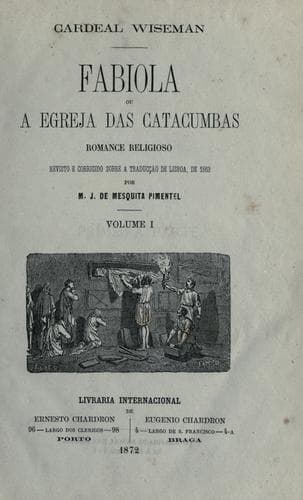
Fabiola; Or, The Church of the CatacombsWiseman, Nicholas Patrick
HistoryHistory
Fabiola; Or, The Church of the Catacombs
Wiseman, Nicholas Patrick
Christian fiction; Church history -- Primitive and early church, ca. 30-600 -- Fiction; Historical fiction
The memorable plot which the black slave betrayed to Corvinus, was one
to which allusion has already been made, in the conversation between
Fulvius and his guardian. He was convinced from the blind martyr’s
unsuspecting admissions, that Agnes was a Christian, and he believed he
had now two strings to his bow; either he could terrify her into
marriage with himself, or he could destroy her, and obtain a good share
of her wealth by confiscation. He was nerved for this second alternative
by the taunts and exhortations of Eurotas; but, despairing of obtaining
another interview, he wrote her a respectful, but pressing letter,
descriptive of his disinterested attachment to her, and entreating her
to accept his suit. There was but the faintest hint at the end, that
duty might compel him to take another course, if humble petition did not
prevail.
To this application he received a calm, well-bred, but unmistakable
refusal; a stern, final, and hopeless rejection. But more, the letter
stated in clear terms, that the writer was already espoused to the
spotless Lamb, and could admit from no perishable being expressions of
personal attachment. This rebuff steeled his heart against pity; but he
determined to act prudently.
In the meantime, Fabiola, seeing the determination of Sebastian not to
fly, conceived the romantic idea of saving him, in spite of himself, by
extorting his pardon from the emperor. She did not know the depth of
wickedness in man’s heart. She thought the tyrant might fume for a
moment, but that he would never condemn a man twice to death. Some pity
and mercy, she thought, must linger in his breast; and her earnest
pleading and tears would extract them, as heat does the hidden balsam
from the hard wood. She accordingly sent a petition for an audience; and
knowing the covetousness of the man, presumed, as she said, to offer him
a slight token of her own and her late father’s loyal attachment. This
was a ring with jewels of rare beauty, and immense value. The present
was accepted; but she was merely told to attend with her memorial at the
Palatine on the 20th, in common with other petitioners, and wait for the
emperor’s descent by the great staircase, on his way to sacrifice.
Unencouraging as was this answer, she resolved to risk any thing, and do
her best.
Public-domain text, read in full here on John Shaqi.
Reviews
Reviews
No reviews yet
Be the first to share your thoughts on this work.
Elsewhere in the archive
Join the Discussion
Join the discussion
Sign in to leave a comment or review.
Sign InorCreate an account