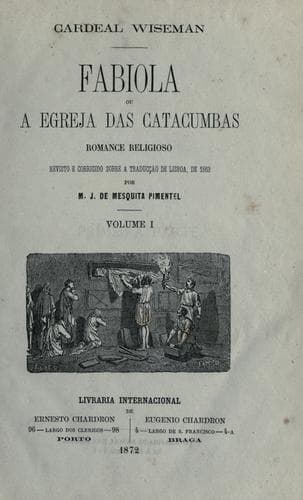
Fabiola; Or, The Church of the CatacombsWiseman, Nicholas Patrick
HistoryHistory
Fabiola; Or, The Church of the Catacombs
Wiseman, Nicholas Patrick
Christian fiction; Church history -- Primitive and early church, ca. 30-600 -- Fiction; Historical fiction
The appointed day came; and Fabiola, in her mourning habits, worn both
as a suppliant, and for her father’s death, took her stand in a row of
far more wretched creatures than herself, mothers, children, sisters,
who held petitions for mercy, for those clearest to them, now in
dungeons or mines. She felt the little hope she had entertained die
within her at the sight of so much wretchedness, too much for it all to
expect favor. But fainter grew its last spark, at every step that the
tyrant took down the marble stairs, though she saw her brilliant ring
sparkling on his coarse hand. For on each step he snatched a paper from
some sorrowful suppliant, looked at it scornfully, and either tore it
up, or dashed it on the ground. Only here and there, he handed one to
his secretary, a man scarcely less imperious than himself.
It was now nearly Fabiola’s turn: the emperor was only two steps above
her, and her heart beat violently, not from fear of man, but from
anxiety about Sebastian’s fate. She would have prayed, had she known
how, or to whom. Maximian was stretching out his hand to take a paper
offered to him, when he drew back, and turned round, on hearing his name
most unceremoniously and peremptorily called out. Fabiola looked up too;
for she knew the voice.
Opposite to her, high in the white marble wall, she had observed an open
window, corniced in yellow marble, which gave light to a back corridor
leading to where Irene’s apartments were. She now looked up, guided by
the voice, and in the dark panel of the window, a beautiful but awful
picture was seen. It was Sebastian, wan and thin, who, with features
almost etherealized, calm and stern, as if no longer capable of passion,
or strong emotion, stood there before them; his lacerated breast and
arms appearing amidst the loose drapery he had thrown around him. For he
had heard the familiar trumpet-notes, which told him of the emperor’s
approach, and he had risen, and crept thus far, to greet him.[190]
“Maximian!” he cried out, in a hollow but distinct voice.
“Who art thou, sirrah! that makest so free with thine emperor’s name?”
asked the tyrant, turning upon him.
Public-domain text, read in full here on John Shaqi.
Reviews
Reviews
No reviews yet
Be the first to share your thoughts on this work.
Elsewhere in the archive
Join the Discussion
Join the discussion
Sign in to leave a comment or review.
Sign InorCreate an account