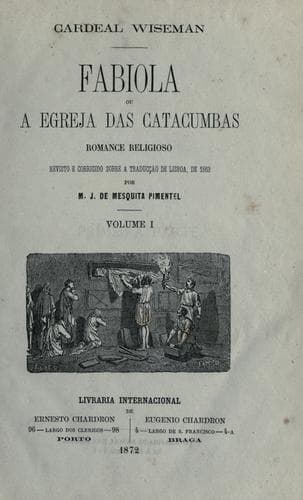
Fabiola; Or, The Church of the CatacombsWiseman, Nicholas Patrick
HistoryHistory
Fabiola; Or, The Church of the Catacombs
Wiseman, Nicholas Patrick
Christian fiction; Church history -- Primitive and early church, ca. 30-600 -- Fiction; Historical fiction
The tyrant, seeing his work completed, ordered that Sebastian at least
should not be cast into the Tiber nor on a dunghill. “Put plenty of
weights to his body,” he added, “and throw it into the Cloaca,[192] to
rot there, and be the food of vermin. The Christians at least shall not
have it.” This was done; and the Saint’s Acts inform us, that in the
night he appeared to the holy matron Lucina, and directed her where to
find his sacred remains. She obeyed his summons, and they were buried
with honor, where now stands his basilica.
[Illustration: Christ blessing a Child, from a picture in the Cemetery
of the Latin Way.]
CHAPTER XXVIII.
THE CRITICAL DAY: ITS FIRST PART.
There are critical days in the life of man and of mankind. Not merely
the days of Marathon, of Cannæ, or of Lepanto, in which a different
result might have influenced the social or political fate of mankind.
But it is probable that Columbus could look back upon not only the day,
but the precise hour, the decision of which secured to the world all
that he taught and gave it, and to himself the singular place which he
holds among its worthies. And each of us, little and insignificant as he
may be, has had his critical day; his day of choice, which has decided
his fate through life; his day of Providence, which altered his position
or his relations to others; his day of grace, when the spiritual
conquered the material. In whatever way it has been, every soul, like
Jerusalem,[193] has had _its_ day.
And so with Fabiola, has not all been working up towards a crisis?
Emperor and slave, father and guest, the good and the wicked, Christian
and heathen, rich and poor; then life and death, joy and sorrow,
learning and simplicity, silence and conversation, have they not all
come as agents, pulling at her mind in opposite ways, yet all directing
her noble and generous, though haughty and impetuous, soul one way, as
the breeze and the rudder struggle against one another, only to
determine the ship’s single path? By what shall the resolution of these
contending forces be determined? That rests not with man; wisdom, not
philosophy, can decide. We have been engaged with events commemorated on
the 20th of January; let the reader look, and see what comes on the
following day in his calendar, and he will agree it must be an important
day in our little narrative.
Public-domain text, read in full here on John Shaqi.
Reviews
Reviews
No reviews yet
Be the first to share your thoughts on this work.
Elsewhere in the archive
Join the Discussion
Join the discussion
Sign in to leave a comment or review.
Sign InorCreate an account