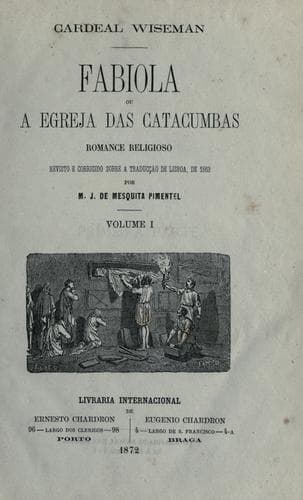
Fabiola; Or, The Church of the CatacombsWiseman, Nicholas Patrick
HistoryHistory
Fabiola; Or, The Church of the Catacombs
Wiseman, Nicholas Patrick
Christian fiction; Church history -- Primitive and early church, ca. 30-600 -- Fiction; Historical fiction
From the audience Fabiola retired to the apartments of Irene, where she
found nothing but desolation and sorrow. She sympathized fully with the
grief around her, but she saw and felt that there was a difference
between her affliction and theirs. There was a buoyancy about them;
there was almost an exultation breaking out through their distress;
their clouds were sun-lit and brightened at times. Hers was a dead and
sullen, a dull and heavy gloom, as if she had sustained a hopeless loss.
Her search after Christianity, as associated with anything amiable or
intelligent, seemed at an end. Her desired teacher, or informant, was
gone. When the crowd had moved away from the palace, she took
affectionate leave of the widow and her daughters; but, some way or
other, she could not like the heathen one as she loved her sister.
She sat alone at home, and tried to read; she took up volume after
volume of favorite works on Death, on Fortitude, on Friendship, on
Virtue; and every one of them seemed insipid, unsound, and insincere.
She plunged into a deeper and a deeper melancholy, which lasted till
towards evening, when she was disturbed by a letter being put into her
hand. The Greek slave, Graja, who brought it in, retired to the other
end of the room, alarmed and perplexed by what she witnessed. For her
mistress had scarcely glanced over the note, than she leaped up wildly
from her seat, threw her hair into disorder with her hands, which she
pressed, as in agony, on her temples, stood thus for a moment, looking
up with an unnatural stare in her eyes, and then sank heavily down again
on her chair with a deep groan. Thus she remained for some minutes,
holding the letter in both her hands, with her arms relaxed, apparently
unconscious.
“Who brought this letter?” she then asked, quite collected.
“A soldier, madam,” answered the maid.
“Ask him to come here.”
While her errand was being delivered, she composed herself, and gathered
up her hair. As soon as the soldier appeared she held this brief
dialogue:
“Whence do you come?”
“I am on guard at the Tullian prison.”
“Who gave you the letter?”
“The Lady Agnes herself.”
“On what cause is the poor child there?”
“On the accusation of a man named Fulvius, for being a Christian.”
“For nothing else?”
“For nothing, I am sure.”
“Then we shall soon set that matter right. I can give witness to the
contrary. Tell her I will come presently; and take this for your
trouble.”
The soldier retired, and Fabiola was left alone. When there was
something to do her mind was at once energetic and concentrated, though
afterwards the tenderness of womanhood might display itself the more
painfully. She wrapped herself close up, proceeded alone to the prison,
and was at once conducted to the separate cell, which Agnes had obtained
in consideration of her rank, backed by her parents’ handsome
largitions.
“What is the meaning of this, Agnes?” eagerly inquired Fabiola, after a
warm embrace.
Public-domain text, read in full here on John Shaqi.
Reviews
Reviews
No reviews yet
Be the first to share your thoughts on this work.
Elsewhere in the archive
Join the Discussion
Join the discussion
Sign in to leave a comment or review.
Sign InorCreate an account