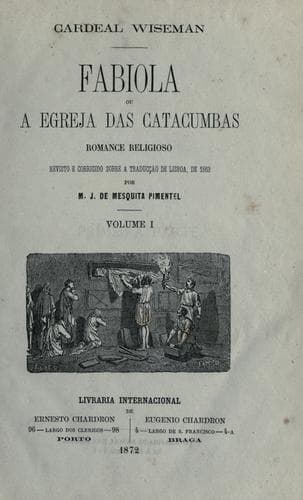
Fabiola; Or, The Church of the CatacombsWiseman, Nicholas Patrick
HistoryHistory
Fabiola; Or, The Church of the Catacombs
Wiseman, Nicholas Patrick
Christian fiction; Church history -- Primitive and early church, ca. 30-600 -- Fiction; Historical fiction
“Yes, to-morrow. To prevent any clamor or disturbance about me (though I
suspect few people will care much), I am to be interrogated early, and
summary proceedings will be taken. Is not that good news, dear?” asked
Agnes eagerly, seizing her cousin’s hands. And then putting on one of
her ecstatic looks, she exclaimed, “Behold, what I have long coveted, I
already see; what I have hoped for, I hold safe; to Him alone I feel
already associated in heaven, whom here on earth I have loved with all
devotedness.[194] Oh! is He not beautiful, Fabiola, lovelier far than
the angels who surround Him! How sweet His smile! how mild His eye! how
bland the whole expression of His face! And that sweetest and most
gracious Lady, who ever accompanies Him, our Queen and Mistress, who
loves Him alone, how winningly doth she beckon me forward to join her
train! I come! I come!--They are departed, Fabiola; but they return
early for me to-morrow; early, mind, and we part no more.”
Fabiola felt her own heart swell and heave, as if a new element were
entering in. She knew not what it was, but it seemed something better
than a mere human emotion. She had not yet heard the name of Grace.
Agnes, however, saw the favorable change in her spirit, and inwardly
thanked God for it. She begged her cousin to return before dawn to her,
for their final farewell.
At this same time a consultation was being held at the house of the
prefect, between that worthy functionary and his worthier son. The
reader had better listen to it, to learn its purport.
“Certainly,” said the magistrate, “if the old sorceress was right in one
thing, she ought to be in the other. I will answer, from experience, how
powerful is wealth in conquering any resistance.”
“And you will allow, too,” rejoined Corvinus, “from the enumeration we
have made, that among the competitors for Fabiola’s hand, there has not
been one who could not justly be rather called an aspirant after her
fortune.”
“Yourself included, my dear Corvinus.”
“Yes, so far: but not if I succeed in offering her, with myself, the
lady Agnes’s great wealth.”
“And in a manner too, methinks, that will more easily gain upon what I
hear of her generous and lofty disposition. Giving her that wealth
independent of conditions, and then offering yourself to her, will put
her under one of two obligations, either to accept you as her husband,
or throw you back the fortune.”
“Admirable, father! I never saw the second alternative before. Do you
think there is no possibility of securing it except through her?”
“None whatever. Fulvius, of course, will apply for his share; and the
probability is, that the emperor will declare he intends to take it all
for himself. For he hates Fulvius. But if I propose a more popular and
palpably reasonable plan, of giving the property to the nearest
relation, who worships the gods--this Fabiola does, don’t she?”
“Certainly, father.”
Public-domain text, read in full here on John Shaqi.
Reviews
Reviews
No reviews yet
Be the first to share your thoughts on this work.
Elsewhere in the archive
Join the Discussion
Join the discussion
Sign in to leave a comment or review.
Sign InorCreate an account