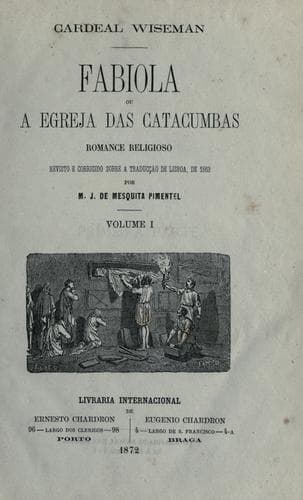
Fabiola; Or, The Church of the CatacombsWiseman, Nicholas Patrick
HistoryHistory
Fabiola; Or, The Church of the Catacombs
Wiseman, Nicholas Patrick
Christian fiction; Church history -- Primitive and early church, ca. 30-600 -- Fiction; Historical fiction
“I think he will embrace it: while I am sure there is no chance of his
making a free gift to me. The proposal from a judge would enrage him.”
“Then how will you manage it, father?”
“I will have an imperial rescript prepared during the night, ready for
signature; and I will proceed immediately after the execution to the
palace, magnify the unpopularity which is sure to follow it, lay it all
on Fulvius, and show the emperor how his granting the property to the
next in the settlement of it, will redound greatly to his credit and
glory. He is as vain as he is cruel and rapacious; and one vice must be
made to fight another.”
“Nothing could be better, my dear father; I shall retire to rest with an
easy mind. To-morrow will be the critical day of my life. All my future
depends upon whether I am accepted or rejected.”
“I only wish,” added Tertullus, rising, “that I could have seen this
peerless lady, and sounded the depths of her philosophy, before your
final bargain was struck.”
“Fear not, father: she is well worthy of being your daughter-in-law.
Yes, to-morrow is indeed the turning-point of my fortunes.”
Even Corvinus can have his critical day. Why not Fabiola?
While this domestic interview was going on, a conference was taking
place between Fulvius and his amiable uncle. The latter, entering late,
found his nephew sitting sullen and alone in the house, and thus
accosted him:
“Well, Fulvius, is she secured?”
“She is, uncle, as fast as bars and walls can make her; but her spirit
is free and independent as ever.”
“Never mind that: sharp steel makes short work of spirit. Is her fate
certain? and are its consequences sure?”
“Why, if nothing else happens, the first is safe; the second have still
to encounter imperial caprice. But I own I feel pain and remorse at
sacrificing so young a life, and for an insecure result.”
“Come, Fulvius,” said the old man sternly, looking as cold as a grey
rock in the morning mist; “no softness, I hope, in this matter. Do you
remember what day is to-morrow?”
“Yes, the twelfth before the calends of February.”[195]
“The critical day always for you. It was on this day that to gain
another’s wealth, you committed----”
“Peace, peace!” interrupted Fulvius in agony. “Why will you always
remind me of every thing I most wish to forget?”
“Because of this: you wish to forget yourself, and that must not be. I
must take from you every pretence to be guided by conscience, virtue, or
even honor. It is folly to affect compassion for any one’s life, who
stands in the way of your fortune, after what you did to _her_.”
Fulvius bit his lip in silent rage, and covered his crimson face with
his hands. Eurotas roused him by saying: “Well, then, to-morrow is
another, and probably a final critical day for you. Let us calmly weigh
its prospects. You will go to the emperor, and ask for your rightful
share in the confiscated property. Suppose it is granted?”
Public-domain text, read in full here on John Shaqi.
Reviews
Reviews
No reviews yet
Be the first to share your thoughts on this work.
Elsewhere in the archive
Join the Discussion
Join the discussion
Sign in to leave a comment or review.
Sign InorCreate an account