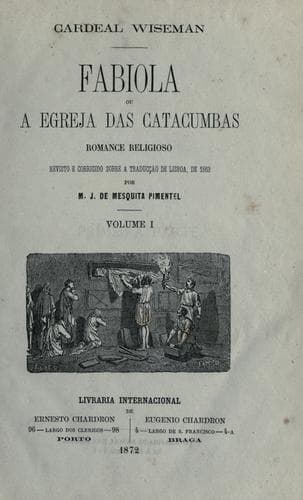
Fabiola; Or, The Church of the CatacombsWiseman, Nicholas Patrick
HistoryHistory
Fabiola; Or, The Church of the Catacombs
Wiseman, Nicholas Patrick
Christian fiction; Church history -- Primitive and early church, ca. 30-600 -- Fiction; Historical fiction
Over the first part of the martyr’s trials we cast a veil of silence,
though ancient Fathers, and the Church in her offices, dwell upon it, as
doubling her crown.[200] Suffice it to say, that her angel protected her
from harm;[201] and that the purity of her presence converted a den of
infamy into a holy and lovely sanctuary.[202] It was still early in the
morning when she stood again before the tribunal of the prefect, in the
Roman Forum; unchanged and unscathed, without a blush upon her smiling
countenance, or a pang of sorrow in her innocent heart. Only her unshorn
hair, the symbol of virginity, which had been let loose, flowed down,
in golden waves, upon her snow-white dress.[203]
It was a lovely morning. Many will remember it to have been a beautiful
day on its anniversary, as they have walked out of the Nomentan gate,
now the Porta Pia, towards the church which bears our virgin-martyr’s
name, to see blessed upon her altar the two lambs, from whose wool are
made the palliums sent by the Pope to the archbishops of his communion.
Already the almond-trees are hoary, not with frost, but with blossoms;
the earth is being loosened round the vines, and spring seems latent in
the swelling buds, which are watching for the signal from the southern
breeze, to burst and expand.[204] The atmosphere, rising into a
cloudless sky, has just that temperature that one loves, of a sun,
already vigorous, not heating, but softening, the slightly frosty air.
Such we have frequently experienced St. Agnes’s day, together with
joyful thousands, hastening to her shrine.
The judge was sitting in the open Forum, and a sufficient crowd formed a
circle round the charmed space, which few, save Christians, loved to
enter. Among the spectators were two whose appearance attracted general
attention; they stood opposite each other, at the ends of the semicircle
formed by the multitude. One was a youth, enveloped in his toga, with a
slouching hat over his eyes, so that his features could not be
distinguished. The other was a lady of aristocratic mien, tall and
erect, such as one does not expect to meet on such an occasion. Wrapped
close about her, and so ample as to veil her from head to foot, like the
beautiful ancient statue, known among artists by the name of
Modesty,[205] she had a scarf or mantle of Indian workmanship, woven in
richest pattern of crimson, purple, and gold, a garment truly imperial,
and less suitable, than even female presence, to this place of doom and
blood. A slave, or servant, of superior class attended her, carefully
veiled also, like her mistress. The lady’s mind seemed intent on one
only object, as she stood immovable, leaning with her elbow on a marble
post.
[Illustration: Chains for the Martyrs, after a picture found in 1841, in
a crypt at Milan.]
Public-domain text, read in full here on John Shaqi.
Reviews
Reviews
No reviews yet
Be the first to share your thoughts on this work.
Elsewhere in the archive
Join the Discussion
Join the discussion
Sign in to leave a comment or review.
Sign InorCreate an account