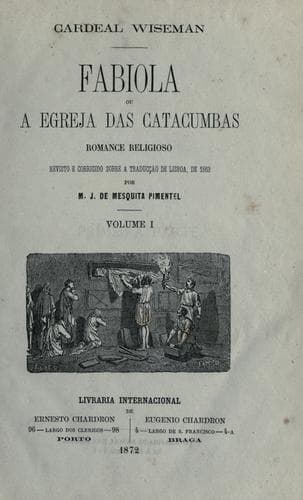
Fabiola; Or, The Church of the CatacombsWiseman, Nicholas Patrick
HistoryHistory
Fabiola; Or, The Church of the Catacombs
Wiseman, Nicholas Patrick
Christian fiction; Church history -- Primitive and early church, ca. 30-600 -- Fiction; Historical fiction
Agnes was introduced by her guards into the open space, and stood
intrepid, facing the tribunal. Her thoughts seemed to be far away; and
she took no notice even of those two who, till she appeared, had been
objects of universal observation.
“Why is she unfettered?” asked the prefect angrily.
“She does not need it: she walks so readily,” answered Catulus; “and she
is so young.”
“But she is obstinate as the oldest. Put manacles on her hands at once.”
The executioner turned over a quantity of such prison ornaments,--to
Christian eyes really such,--and at length selected a pair as light and
small as he could find, and placed them round her wrists. Agnes
playfully, and with a smile,
[Illustration: The judge angrily reproved the executioner for his
hesitation, and bid him at once do his duty.]
shook her hands, and they fell, like St. Paul’s viper, clattering at her
feet.[206]
“They are the smallest we have, sir,” said the softened executioner:
“one so young ought to wear other bracelets.”
“Silence, man!” rejoined the exasperated judge, who, turning to the
prisoner, said, in a blander tone:
“Agnes, I pity thy youth, thy station, and the bad education thou hast
received. I desire, if possible, to save thee. Think better while thou
hast time. Renounce the false and pernicious maxims of Christianity,
obey the imperial edicts, and sacrifice to the gods.”
“It is useless,” she replied, “to tempt me longer. My resolution is
unalterable. I despise thy false divinities, and can only love and serve
the one living God. Eternal Ruler, open wide the heavenly gates, until
lately closed to man. Blessed Christ, call to Thee the soul that
cleaveth unto Thee: victim first to Thee by virginal consecration; now
to Thy Father by martyrdom’s immolation.”[207]
“I waste time, I see,” said the impatient prefect, who saw symptoms of
compassion rising in the multitude. “Secretary, write the sentence. We
condemn Agnes, for contempt of the imperial edicts, to be punished by
the sword.”
“On what road, and at what mile-stone, shall the judgment be
executed?”[208] asked the headsman.
“Let it be carried into effect at once,” was the reply.
Agnes raised for one moment her hands and eyes to heaven, then calmly
knelt down. With her own hands she drew forward her silken hair over
her head, and exposed her neck to the blow.[209] A pause ensued, for the
executioner was trembling with emotion, and could not wield his
sword.[210] As the child knelt alone, in her white robe, with her head
inclined, her arms modestly crossed upon her bosom, and her amber locks
hanging almost to the ground, and veiling her features, she might not
unaptly have been compared to some rare plant, of which the slender
stalk, white as the lily, bent with the luxuriancy of its golden
blossom.
Public-domain text, read in full here on John Shaqi.
Reviews
Reviews
No reviews yet
Be the first to share your thoughts on this work.
Elsewhere in the archive
Join the Discussion
Join the discussion
Sign in to leave a comment or review.
Sign InorCreate an account