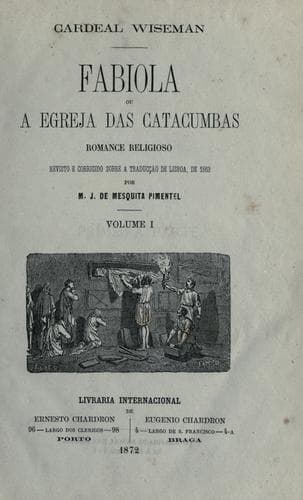
Fabiola; Or, The Church of the CatacombsWiseman, Nicholas Patrick
HistoryHistory
Fabiola; Or, The Church of the Catacombs
Wiseman, Nicholas Patrick
Christian fiction; Church history -- Primitive and early church, ca. 30-600 -- Fiction; Historical fiction
Fabiola gracefully thanked the prefect, and beckoned to Syra, who
attended her. The servant again made a signal to some one else; and
presently four slaves appeared bearing a lady’s litter. Fabiola would
allow no one but herself and Syra to raise the relics from the ground,
place them on the litter, and cover them with their precious pall. “Bear
this treasure to its own home,” she said, and followed as mourner with
her maid. A little girl, all in tears, timidly asked if she might join
them.
[Illustration: A Blood Urn, used as a mark for a martyr’s grave.]
“Who art thou?” asked Fabiola.
“I am poor Emerentiana, _her_ foster-sister,” replied the child; and
Fabiola led her kindly by the hand.
The moment the body was removed, a crowd of Christians, children, men,
and women, threw themselves forward, with sponges and linen cloths, to
gather up the blood. In vain did the guards fall on them, with whips,
cudgels, and even with sharper weapons, so that many mingled their own
blood with that of the martyr. When a sovereign, at his coronation, or
on first entering his capital, throws, according to ancient custom,
handfuls of gold and silver coins among the crowd, he does not create a
more eager competition for his scattered treasures, than there was among
those primitive Christians, for what they valued more than gold or
precious stones, the ruby drops which a martyr had poured from his heart
for his Lord. But all respected the prior claim of one; and here it was
the deacon Reparatus, who, at risk of life, was present, phial in hand,
to gather the blood of Agnes’s testimony; that it might be appended, as
a faithful seal, to the record of martyrdom on her tomb.
[Illustration: The Resurrection of Lazarus, from the Cemetery of St.
Domitilla.]
CHAPTER XXX.
THE SAME DAY: ITS THIRD PART.
Tertullus hastened at once to the palace: fortunately, or unfortunately,
for these candidates for martyrdom. There he met Corvinus, with the
prepared rescript, elegantly engrossed in _unical_, that is, large
capital letters. He had the privilege of immediate admission into the
imperial presence; and, as a matter of business, reported the death of
Agnes, exaggerated the public feeling likely to be caused by it,
attributed it all to the folly and mismanagement of Fulvius, whose worst
guilt he did not disclose for fear of having to try him, and thus
bringing out what he was now doing; depreciated the value of Agnes’s
property, and ended by saying that it would be a gracious act of
clemency, and one sure to counteract unpopular feelings, to bestow it
upon her relative, who by settlement was her next heir. He described
Fabiola as a young lady of extraordinary intellect and wonderful
learning, who was most zealously devoted to the worship of the gods, and
daily offered sacrifice to the genius of the emperors.
Public-domain text, read in full here on John Shaqi.
Reviews
Reviews
No reviews yet
Be the first to share your thoughts on this work.
Elsewhere in the archive
Join the Discussion
Join the discussion
Sign in to leave a comment or review.
Sign InorCreate an account