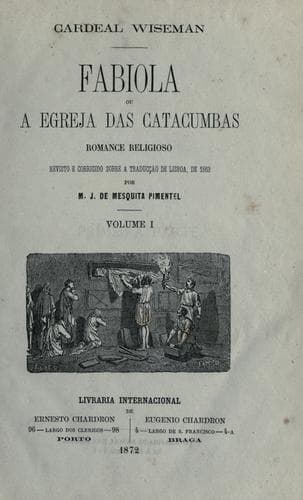
Fabiola; Or, The Church of the CatacombsWiseman, Nicholas Patrick
HistoryHistory
Fabiola; Or, The Church of the Catacombs
Wiseman, Nicholas Patrick
Christian fiction; Church history -- Primitive and early church, ca. 30-600 -- Fiction; Historical fiction
“I know her,” said Maximian, laughing, as if at the recollection of
something very droll. “Poor thing! she sent me a splendid ring, and
yesterday asked me for that wretched Sebastian’s life, just as they had
finished cudgelling him to death.” And he laughed immoderately, then
continued: “Yes, yes, by all means; a little inheritance will console
her, no doubt, for the loss of that fellow. Let a rescript be made out,
and I will sign it.”
Tertullus produced the one prepared, saying he had fully relied on the
emperor’s magnanimous clemency; and the imperial barbarian put a
signature to it which would have disgraced a schoolboy. The prefect at
once consigned it to his son.
Scarcely had he left the palace, when Fulvius entered. He had been home
to put on a proper court attire, and remove from his features, by the
bath and the perfumer’s art, the traces of his morning’s passion. He
felt a keen presentiment that he should be disappointed. Eurotas’s cool
discussion of the preceding evening had prepared him; the cross of all
his designs, and his multiplied disappointments that day, had
strengthened this instinctive conviction. One woman, indeed, seemed born
to meet and baffle him whichever way he turned; but, “thank the gods,”
he thought, “she cannot be in my way here. She has this morning blasted
my character for ever; she cannot claim my rightful reward; she has made
me an outcast; it is not in her power to make me a beggar.” This seemed
his only ground of hope. Despair, indeed, urged him forward; and he
determined to argue out his claims to the confiscated property of Agnes,
with the only competitor he could fear, the rapacious emperor himself.
He might as well risk his life over it, for if he failed, he was utterly
ruined. After waiting some time, he entered the audience-hall, and
advanced with the blandest smile that he could muster to the imperial
feet.
“What want you here?” was his first greeting.
“Sire,” he replied, “I have come humbly to pray your royal justice, to
order my being put into immediate possession of my share of the Lady
Agnes’s property. She has been convicted of being a Christian upon my
accusation, and she has just suffered the merited penalty of all who
disobey the imperial edicts.”
“That is all quite right; but we have heard how stupidly you mismanaged
the whole business as usual, and have raised murmurings and discontent
in the people against us. So, now, the sooner you quit our presence,
palace, and city, the better for yourself. Do you understand? We don’t
usually give such warnings twice.”
“I will obey instantly every intimation of the supreme will. But I am
almost destitute. Command what of right is mine to be delivered over to
me, and I part immediately.”
“No more words,” replied the tyrant, “but go at once. As to the property
which you demand with so much pertinacity, you cannot have it. We have
made over the whole of it, by an irrevocable rescript, to an excellent
and deserving person, the Lady Fabiola.”
Public-domain text, read in full here on John Shaqi.
Reviews
Reviews
No reviews yet
Be the first to share your thoughts on this work.
Elsewhere in the archive
Join the Discussion
Join the discussion
Sign in to leave a comment or review.
Sign InorCreate an account