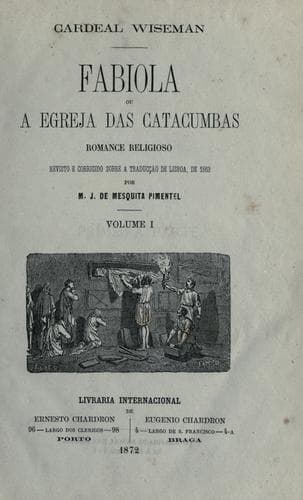
Fabiola; Or, The Church of the CatacombsWiseman, Nicholas Patrick
HistoryHistory
Fabiola; Or, The Church of the Catacombs
Wiseman, Nicholas Patrick
Christian fiction; Church history -- Primitive and early church, ca. 30-600 -- Fiction; Historical fiction
Fabiola was amazed, and her displeasure was somewhat mitigated, by the
ridiculous appearance of the person deputed in such a solemn character.
It was Corvinus, who with clownish grace approached her, and in a
studied speech, evidently got up very floridly, and intrusted to a bad
memory, laid at her feet an imperial rescript, and his own sincere
affection, the Lady Agnes’s estates, and his clumsy hand. Fabiola could
not at all comprehend the connection between the two combined presents,
and never imagined that the one was a bribe for the other. So she
desired him to return her humble thanks to the emperor for his gracious
act; adding, “Say that I am too ill to-day to present myself, and do him
homage.”
“But these estates, you are aware, were forfeited and confiscated,” he
gasped out in great confusion, “and my father has obtained them for
you.”
“That was unnecessary,” said Fabiola, “for they were settled on me long
ago, and became mine the moment”--she faltered, and after a strong
effort at self-mastery, she continued--“the moment they ceased to be
another’s; they did not fall under confiscation.”
Corvinus was dumb-foundered: at last he stumbled into something, meant
for an humble petition to be admitted as an aspirant after her hand, but
understood by Fabiola to be a demand of recompense, for procuring or
bringing so important a document. She assured him that every claim he
might have on her should be fully and honorably considered at a more
favorable moment; but as she was exceedingly wearied and unwell, she
must beg him to leave her at present. He did so quite elated, fancying
that he had secured his prize.
After he was gone she hardly looked at the parchment, which he had left
open on a small table by her couch, but sat musing on the sorrowful
scenes she had witnessed, till it wanted about an hour to sunset.
Sometimes her reveries turned to one point, sometimes to another of the
late events; and, at last, she was dwelling on her being confronted with
Fulvius, that morning, in the Forum. Her memory vividly replaced the
entire scene before her, and her mind gradually worked itself into a
state of painful excitement, which she at length checked by saying aloud
to herself: “Thank heaven! I shall never behold that villain’s face
again.”
The words were scarcely out of her mouth, when she shaded her eyes with
her hand, as she raised herself up on her couch, and looked towards the
door. Was it her overheated fancy which beguiled her, or did her wakeful
eyes show her a reality? Her ears decided the question, by these words
which they heard:
“Pray, madam, who is the man whom you honor by that gracious speech?”
“You, Fulvius,” she said, rising with dignity. “A further intruder
still; not only into the house, the villa, and the dungeon, but into the
most secret apartments of a lady’s residence; and what is worse, into
the house of sorrow of one whom you have bereaved. Begone at once, or I
will have you ignominiously expelled hence.”
Public-domain text, read in full here on John Shaqi.
Reviews
Reviews
No reviews yet
Be the first to share your thoughts on this work.
Elsewhere in the archive
Join the Discussion
Join the discussion
Sign in to leave a comment or review.
Sign InorCreate an account