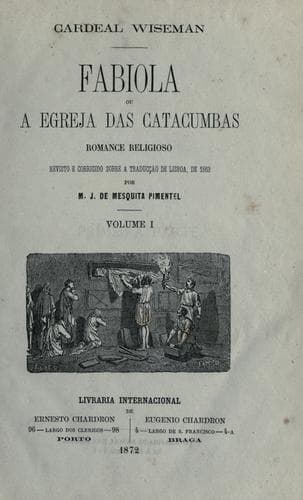
Fabiola; Or, The Church of the CatacombsWiseman, Nicholas Patrick
HistoryHistory
Fabiola; Or, The Church of the Catacombs
Wiseman, Nicholas Patrick
Christian fiction; Church history -- Primitive and early church, ca. 30-600 -- Fiction; Historical fiction
No; Fabiola returned home, exhausted almost by the preceding day and
night, and the sad scenes of the morning, and retired to her own
apartment, no longer perhaps even a philosopher, yet not a Christian.
She desired all her servants to keep away from the court which she
occupied, that she might not be disturbed by the smallest noise; and she
forbade any one to have access to her. There she sat in loneliness and
silence, for several hours, too excited to obtain rest from slumber. She
mourned long over Agnes, as a mother might over a child suddenly carried
off. Yet, was there not a tinge of light upon the cloud that
overshadowed her, more than when it hung over her father’s bier? Did it
not seem to her an insult to reason, an outrage to humanity, to think
that _she_ had perished; that she had been permitted to walk forward in
her bright robe, and with her smiling countenance, and with her joyous,
simple heart, straight on--into nothing; that she had been allured by
conscience, and justice, and purity, and truth, on, on, till with arms
outstretched to embrace them, she stepped over a precipice, beneath
which yawned annihilation? No. Agnes, she felt sure, was happy somehow,
somewhere; or justice was a senseless word.
“How strange,” she further thought, “that every one whom I have known
endowed with superior excellence, men like Sebastian, women like Agnes,
should turn out to have belonged to the scorned race of Christians! One
only remains, and to-morrow I will interrogate her.”
When she turned from these, and looked round upon the heathen world,
Fulvius, Tertullus, the Emperor, Calpurnius,--nay, she shuddered as she
surprised herself on the point of mentioning her own father’s name--it
sickened her to see the contrast of baseness with nobleness, vice with
virtue, stupidity with wisdom, and the sensual with the spiritual. Her
mind was thus being shaped into a mould, which some form of practical
excellence must be found to fill, or it must be broken; her soul was
craving as a parched soil, which heaven must send its waters to refresh,
or it must become an eternal desert.
Agnes, surely, well deserved the glory of gaining, by her death, her
kinswoman’s conversion; but was there not one, more humble, who had
established a prior claim? One who had given up freedom, and offered
life, for this unselfish gain?
While Fabiola was alone and desolate, she was disturbed by the entrance
of a stranger, introduced under the ominous title of “A messenger from
the emperor.” The porter had at first denied him admittance; but upon
being assured that he bore an important embassy from the sovereign, he
felt obliged to inquire from the steward what to do; when he was
informed that no one with such a claim could be refused entrance.
Public-domain text, read in full here on John Shaqi.
Reviews
Reviews
No reviews yet
Be the first to share your thoughts on this work.
Elsewhere in the archive
Join the Discussion
Join the discussion
Sign in to leave a comment or review.
Sign InorCreate an account