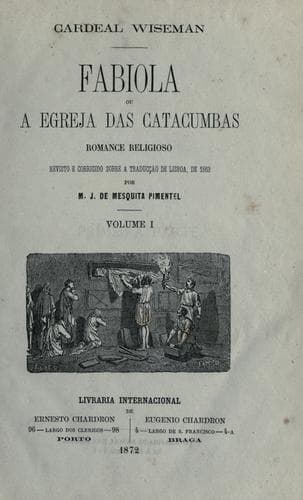
Fabiola; Or, The Church of the CatacombsWiseman, Nicholas Patrick
HistoryHistory
Fabiola; Or, The Church of the Catacombs
Wiseman, Nicholas Patrick
Christian fiction; Church history -- Primitive and early church, ca. 30-600 -- Fiction; Historical fiction
“Your love!” now broke in the indignant lady; “even if all that you have
said were not basely false, what love could you have for _her_? How
could _you_ appreciate her artless simplicity, her genuine honesty, her
rare understanding, her candid innocence, any more than the wolf can
value the lamb’s gentleness, or the vulture the dove’s mildness? No, it
was her wealth, her family connection, her nobility, that you grasped
at, and nothing more; I read it in the very flash of your eye, when
first it fixed itself, as a basilisk’s, upon her.”
“It is false!” he rejoined; “had I obtained my request, had I been thus
worthily mated, I should have been found equal to my position, domestic,
contented, and affectionate; as worthy of possessing her as----”
“As any one can be,” struck in Fabiola, “who, in offering his hand,
expresses himself equally ready, in three hours, to espouse or to murder
the object of his affection. And she prefers the latter, and he keeps
his word. Begone from my presence; you taint the very atmosphere in
which you move.”
“I will leave when I have accomplished my task, and you will have little
reason to rejoice when I do. You have then purposely, and unprovoked,
blighted and destroyed in me every honorable purpose of life, withered
my only hope, cut me off from rank, society, respectable ease, and
domestic happiness.
“That was not enough. After acting in that character, with which you
summed up my condemnation, of a spy, and listened to my conversation,
you this morning threw off all sense of female propriety, and stood
forward prominently in the Forum, to complete in public what you had
begun in private, excite against me the supreme tribunal, and through it
the emperor, and arouse an unjust popular outcry and vengeance; such as,
but for a feeling stronger than fear, which brings me hither, would
make me now skulk, like a hunted wolf, till I could steal out of the
nearest gate.”
“And, Fulvius, I tell you,” interposed Fabiola, “that the moment you
cross its threshold, the average of virtue will be raised in this wicked
city. Again I bid you depart from my house, at least; or at any rate I
will withdraw from this offensive intrusion.”
“We part not yet, lady,” said Fulvius, whose countenance had been
growing every moment more flushed, as his lips had been becoming more
deadly pale. He rudely grasped her arm, and pushed her back to her seat;
“and beware,” he added, “how you attempt again either to escape or to
bring aid; your first cry will be your last, cost me what it may.
“You have made me, then, an outcast, not only from society but from
Rome, an exile, a houseless wanderer on a friendless earth; was not that
enough to satisfy your vengeance? No: you must needs rob me of my gold,
of my rightfully, though painfully earned wealth; peace, reputation, my
means of subsistence, all _you_ have stolen from me, a youthful
stranger.”
Public-domain text, read in full here on John Shaqi.
Reviews
Reviews
No reviews yet
Be the first to share your thoughts on this work.
Elsewhere in the archive
Join the Discussion
Join the discussion
Sign in to leave a comment or review.
Sign InorCreate an account