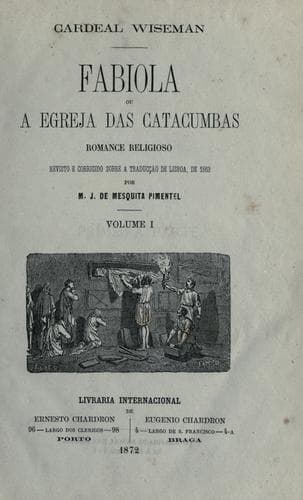
Fabiola; Or, The Church of the CatacombsWiseman, Nicholas Patrick
HistoryHistory
Fabiola; Or, The Church of the Catacombs
Wiseman, Nicholas Patrick
Christian fiction; Church history -- Primitive and early church, ca. 30-600 -- Fiction; Historical fiction
“Wicked and insolent man!” exclaimed now the indignant Roman lady,
reckless of consequences, “you shall answer heavily for your temerity.
Dare you, in my own house, call me a thief?”
“I dare; and I tell you this is your day of reckoning, and not mine. I
have earned, even if by crime, it is nothing to you, my full share of
your cousin’s confiscated property. I have earned it hardly, by pangs
and rendings of the heart and soul, by sleepless nights of struggles
with fiends that have conquered; ay, and with one at home that is
sterner than they; by days and days of restless search for evidence,
amidst the desolation of a proud, but degraded spirit. Have I not a
right to enjoy it?
“Ay, call it what you will, call it my blood-money; the more infamous
it is, the more base in you to step in and snatch it from me. It is like
a rich man tearing the carrion from the hound’s jaws, after he has
swollen his feet and rent his skin in hunting it down.”
“I will not seek for further epithets by which to call you; your mind is
deluded by some vain dream,” said Fabiola, with an earnestness not
untinged with alarm. She felt she was in the presence of a madman, one
in whom violent passion, carried off by an unchecked, deeply-moved
fancy, was lashing itself up to that intensity of wicked excitement,
which constitutes a moral frenzy,--when the very murderer thinks himself
a virtuous avenger. “Fulvius,” she continued, with studied calmness, and
looking fully into his eyes, “I now _entreat_ you to go. If you want
money, you shall have it; but go, in heaven’s name go, before you
destroy your reason by your anger.”
“What vain fancy do you mean?” asked Fulvius.
“Why, that I should have ever dreamt about Agnes’s wealth or property on
such a day, or should have taken any advantage of her cruel death.”
“And yet it is so; I have it from the emperor’s mouth that he has made
it over to you. Will you pretend to make me believe, that this most
generous and liberal prince ever parted with a penny unsolicited, ay, or
unbribed?”
“Of this I know nothing. But I know, that I would rather have died of
want than petitioned for a farthing of such property!”
“Then would you make me rather believe, that in this city there is any
one so disinterested as, undesired, to have petitioned for you? No, no,
Lady Fabiola, all this is too incredible. But what is that?” And he
pounced with eagerness on the imperial rescript, which had remained
unlooked at, since Corvinus had left it. The sensation to him was like
that of Æneas when he saw Pallas’s belt upon the body of Turnus. The
fury, which seemed to have been subdued by his subtlety, as he had been
reasoning to prove Fabiola guilty, flashed up anew at the sight of this
fatal document. He eyed it for a minute, then broke out, gnashing his
teeth with rage:
Public-domain text, read in full here on John Shaqi.
Reviews
Reviews
No reviews yet
Be the first to share your thoughts on this work.
Elsewhere in the archive
Join the Discussion
Join the discussion
Sign in to leave a comment or review.
Sign InorCreate an account