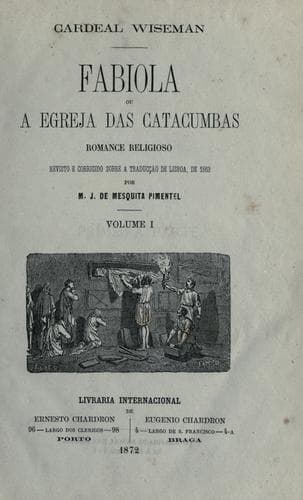
Fabiola; Or, The Church of the CatacombsWiseman, Nicholas Patrick
HistoryHistory
Fabiola; Or, The Church of the Catacombs
Wiseman, Nicholas Patrick
Christian fiction; Church history -- Primitive and early church, ca. 30-600 -- Fiction; Historical fiction
“And leave you to possess what is mine? leave you to triumph over me, as
one whom you have outwitted--you honored, and I disgraced--you rich, and
I penniless--you happy, and I wretched? No, never! I cannot save myself
from what you have made me; but I can prevent your being what you have
no right to be. For this I have come here; this is my day of
Nemesis.[213] Now die!” While he was speaking these reproaches, he was
slowly pushing her backwards with his left hand towards the couch from
which she had risen; while his right was tremblingly feeling for
something in the folds of his bosom.
As he finished his last word, he thrust her violently down upon the
couch, and seized her by the hair. She made no resistance, she uttered
no cry; partly a fainting and sickening sensation came over her; partly
a noble feeling of self-respect checked any unseemly exhibition of fear,
before a scornful enemy. Just as she closed her eyes, she saw something
like lightning above her; she could not tell whether it was his glaring
eye or flashing steel.
In another moment she felt oppressed and suffocated, as if a great
weight had fallen upon her; and a hot stream was flowing over her bosom.
A sweet voice full of earnestness sounded in her ears:
“Cease, Orontius; I am thy sister Miriam!”
Fulvius, in accents choked by passion, replied:
“It is false; give me up my prey!”
A few words more were faintly spoken in a tongue unknown to Fabiola;
when she felt her hair released, heard the dagger dashed to the ground,
and Fulvius cry out bitterly, as he rushed out of the room:
“O Christ! this is Thy Nemesis!”
Fabiola’s strength was returning; but she felt the weight upon her
increase. She struggled, and released herself. Another body was lying in
her place, apparently dead, and covered with blood.
It was the faithful Syra, who had thrown herself between her mistress’s
life and her brother’s dagger.
CHAPTER XXXI.
DIONYSIUS.
+----------+[214]
| ΔΙΟΝΥCΙΟΥ |
| ΙΑΤΡΟΥ |
|ΠΡΕCΒΥΤΕΡΟΥ |
+-----------+
The great thoughts, which this occurrence would naturally have suggested
to the noble heart of Fabiola, were suppressed, for a time, by the
exigencies of the moment. Her first care was to stanch the flowing blood
with whatever was nearest at hand. While she was engaged in this work,
there was a general rush of servants towards her apartment. The stupid
porter had begun to be uneasy at Fulvius’s long stay (the reader has now
heard his real name), when he saw him dash out of the door like a
maniac, and thought he perceived stains of blood upon his garment. He
immediately gave the alarm to the entire household.
Public-domain text, read in full here on John Shaqi.
Reviews
Reviews
No reviews yet
Be the first to share your thoughts on this work.
Elsewhere in the archive
Join the Discussion
Join the discussion
Sign in to leave a comment or review.
Sign InorCreate an account