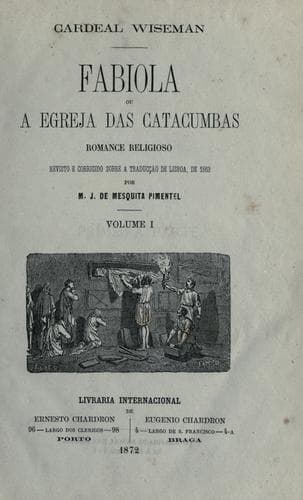
Fabiola; Or, The Church of the CatacombsWiseman, Nicholas Patrick
HistoryHistory
Fabiola; Or, The Church of the Catacombs
Wiseman, Nicholas Patrick
Christian fiction; Church history -- Primitive and early church, ca. 30-600 -- Fiction; Historical fiction
Fabiola by a gesture stopped the crowd at the door of her room, and
desired only Euphrosyne and her Greek maid to enter. The latter, since
the influence of the black slave had been removed, had attached herself
most affectionately to Syra, as we must still call her, and had, with
great docility, listened to her moral instructions. A slave was
instantly despatched for the physician who had always been sent for by
Syra in illness, Dionysius, who, as we have already observed, lived in
the house of Agnes.
In the meantime Fabiola had been overjoyed at finding the blood cease to
flow so rapidly, and still more at seeing her servant open her eyes upon
her, though only for a moment. She would not have exchanged for any
wealth the sweet smile which accompanied that look.
[Illustration: Cemetery of Callistus.]
In a few minutes the kind physician arrived. He carefully examined the
wound, and pronounced favorably on it for the present. The blow, as
aimed, would have gone straight to Fabiola’s heart. But her loving
servant, in spite of prohibition, had been hovering near her mistress
during the whole day; never intruding, but anxious for any opportunity
which might offer, of seconding those good impressions of grace, which
the morning’s scenes could not fail to have produced. While in a
neighboring room she heard violent tones which were too familiar to her
ears; and hastened noiselessly round, and within the curtain which
covered the door of Fabiola’s own apartment. She stood concealed in the
dusk, on the very spot where Agnes had, a few months before, consoled
her.
She had not been there long when the last struggle commenced. While the
man was pushing her mistress backwards, she followed him close behind;
and as he was lifting his arm, passed him, and threw her body over that
of his victim. The blow descended, but misdirected, through the shock
she gave his arm; and it fell upon her neck, where it inflicted a deep
wound, checked, however, by encountering the collar-bone. We need not
say what it cost her to make this sacrifice. Not the dread of pain, nor
the fear of death could for a moment have deterred her; it was the
horror of imprinting on her brother’s brow the mark of Cain, the making
him doubly a fratricide, which deeply anguished her. But she had offered
her life for her mistress. To have fought with the assassin, whose
strength and agility she knew, would have been useless; to try to alarm
the house before one fatal blow was struck was hopeless; and nothing
remained but to accomplish her immolation, by substituting herself for
the intended victim. Still she wished to spare her brother the
consummation of his crime, and in doing so manifested to Fabiola their
relationship and their real names.
Public-domain text, read in full here on John Shaqi.
Reviews
Reviews
No reviews yet
Be the first to share your thoughts on this work.
Elsewhere in the archive
Join the Discussion
Join the discussion
Sign in to leave a comment or review.
Sign InorCreate an account