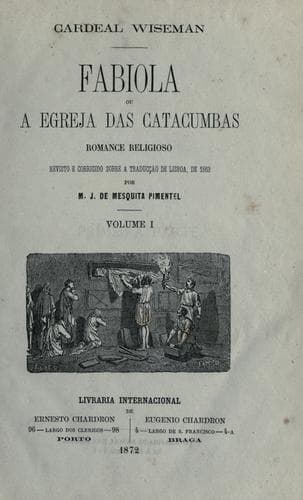
Fabiola; Or, The Church of the CatacombsWiseman, Nicholas Patrick
HistoryHistory
Fabiola; Or, The Church of the Catacombs
Wiseman, Nicholas Patrick
Christian fiction; Church history -- Primitive and early church, ca. 30-600 -- Fiction; Historical fiction
Some years before our story commenced, there lived in Antioch a man who,
though not of ancient family, was rich, and moved in the highest circles
of that most luxurious city. To keep his position, he was obliged to
indulge in great expense; and from want of strict economy, he had
gradually become oppressed with debt. He was married to a lady of great
virtue, who became a Christian, at first secretly, and afterwards
continued so, with her husband’s reluctant consent. In the meantime
their two children, a son and daughter, had received their domestic
education under her care. The former, Orontius, so called from the
favorite stream which watered the city, was fifteen when his father
first discovered his wife’s religion. He had learnt much from his mother
of the doctrines of Christianity, and had been with her an attendant on
Christian worship; and hence he possessed a dangerous knowledge, of
which he afterwards made so fatal a use.
But he had not the least inclination to embrace the doctrines, or adopt
the practices of Christianity; nor would he hear of preparing for
baptism. He was wilful and artful, with no love for any restraint upon
his passions, or for any strict morality. He looked forward to
distinction in the world, and to his full share in all its enjoyments.
He had been, and continued to be, highly educated; and besides the Greek
language, then generally spoken at Antioch, he was acquainted with
Latin, which he spoke readily and gracefully, as we have seen, though
with a slight foreign accent. In the family, the vernacular idiom was
used with servants, and often in familiar conversation. Orontius was not
sorry when his father removed him from his mother’s control, and
insisted that he should continue to follow the dominant and favored
religion of the state.
As to the daughter, who was three years younger, he did not so much
care. He deemed it foolish and unmanly to take much trouble about
religion; to change it especially, or abandon that of the empire, was,
he thought, a sign of weakness. But women being more imaginative, and
more under the sway of the feelings, might be indulged in any fancies of
this sort. Accordingly he permitted his daughter Miriam, whose name was
Syrian, as the mother belonged to a rich family from Edessa, to continue
in the free exercise of her new faith. She became, in addition to her
high mental cultivation, a model of virtue, simple and unpretending. It
was a period, we may observe, in which the city of Antioch was renowned
for the learning of its philosophers, some of whom were eminent as
Christians.
Public-domain text, read in full here on John Shaqi.
Reviews
Reviews
No reviews yet
Be the first to share your thoughts on this work.
Elsewhere in the archive
Join the Discussion
Join the discussion
Sign in to leave a comment or review.
Sign InorCreate an account