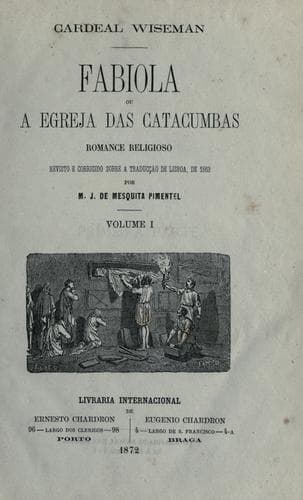
Fabiola; Or, The Church of the CatacombsWiseman, Nicholas Patrick
HistoryHistory
Fabiola; Or, The Church of the Catacombs
Wiseman, Nicholas Patrick
Christian fiction; Church history -- Primitive and early church, ca. 30-600 -- Fiction; Historical fiction
Fabiola, on awaking, crept back to her own couch, as she thought,
unobserved. A secret, sharp pang it had cost her to perform this act of
self-abasement; but she had thoroughly humbled the pride of her heart.
She felt for the first time that her heart was Christian.
CHAPTER XXXIII.
MIRIAM’S HISTORY.
The next morning, when Dionysius came, he found both patient and nurse
so radiant and so happy, that he congratulated them both on having had a
good night’s rest. Both laughed at the idea; but concurred in saying
that it had been the happiest night of their lives. Dionysius was
surprised, till Miriam, taking the hand of Fabiola, said:
“Venerable priest of God, I confide to your fatherly care this
catechumen, who desires to be fully instructed in the mysteries of our
holy faith, and to be regenerated by the waters of eternal salvation.”
“What!” asked Fabiola, amazed, “are you more than a physician?”
“I am, my child,” the old man replied; “unworthily I hold likewise the
higher office of a priest in God’s Church.”
Fabiola unhesitatingly knelt before him, and kissed his hand. The priest
placed his right hand upon her head, and said to her:
“Be of good courage, daughter; you are not the first of your house whom
God has brought into His holy Church. It is now many years since I was
called in here, under the guise of a physician, by a former servant, now
no more; but in reality it was to baptize, a few hours before her death,
the wife of Fabius.”
“My mother!” exclaimed Fabiola. “She died immediately after giving me
birth. And did she die a Christian?”
“Yes; and I doubt not that her spirit has been hovering about you
through life by the side of the angel who guards you, guiding you unseen
to this blessed hour. And, before the throne of God, she has been
unceasing in her supplications on your behalf.”
Joy tenfold filled the breasts of the two friends; and after
arrangements had been made with Dionysius for the necessary instructions
and preparations for Fabiola’s admission to baptism, she went up to the
side of Miriam, and taking her hand, said to her in a low, soft voice:
“Miriam, may I from henceforth call you sister?” A pressure of the hand
was the only reply which she could give.
With their mistress, the old nurse, Euphrosyne, and the Greek slave,
placed themselves, as we now say, under instruction, to receive baptism
on Easter-eve. Nor must we forget one who was already enrolled in the
list of catechumens, and whom Fabiola had taken home with her and kept,
Emerentiana, the foster-sister of Agnes. It was her delight to make
herself useful, by being the ready messenger between the sick-room and
the rest of the house.
During her illness, as her strength improved, Miriam imparted many
particulars of her previous life to Fabiola; and as they will throw some
light on our preceding narrative, we will give her history in a
continuous form.
Public-domain text, read in full here on John Shaqi.
Reviews
Reviews
No reviews yet
Be the first to share your thoughts on this work.
Elsewhere in the archive
Join the Discussion
Join the discussion
Sign in to leave a comment or review.
Sign InorCreate an account