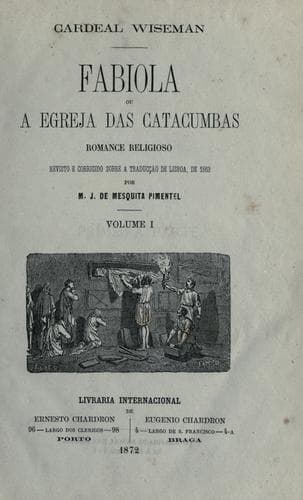
Fabiola; Or, The Church of the CatacombsWiseman, Nicholas Patrick
HistoryHistory
Fabiola; Or, The Church of the Catacombs
Wiseman, Nicholas Patrick
Christian fiction; Church history -- Primitive and early church, ca. 30-600 -- Fiction; Historical fiction
the martial tread of Sebastian, and hastily he snatched up from the
ground the rich scarf which had dropped from Syra’s arm. He shook as he
folded it up; and when, to his horror, he found upon it spots of fresh
blood, which had oozed through the bandages, he reeled like a drunken
man to the door, and rushed to his lodgings.
Pale, sick, and staggering, he went into his chamber, repulsing roughly
the officious advances of his slaves; and only beckoned to his faithful
domestic to follow him, and then signed to him to bar the door. A lamp
was burning brightly by the table, on which Fulvius threw the
embroidered scarf in silence, and pointed to the stains of blood. That
dark man said nothing; but his swarthy countenance was blanched, while
his master’s was ashy and livid.
“It is the same, no doubt,” at length spoke the attendant in their
foreign tongue; “but _she_ is certainly dead.”
“Art thou quite sure, Eurotas?” asked the master, with the keenest of
his hawk’s looks.
“As sure as man can be of what he has not seen himself. Where didst thou
find this? And whence this blood?”
“I will tell thee all to-morrow; I am too sick to-night. As to those
stains, which were liquid when I found it, I know not whence they came,
unless they are warnings of vengeance--nay, a vengeance themselves, deep
as the Furies could meditate, fierce as they could launch. That blood
has not been shed _now_.”
“Tut, tut! this is no time for dreams or fancies. Did any one see thee
pick the--the thing up?”
“No one, I am sure.”
“Then we are safe; better in our hands than in others’. A good night’s
rest will give us better counsel.”
“True, Eurotus; but do thou sleep this night in my chamber.”
Both threw themselves on their couches; Fulvius on a rich bed, Eurotus
on a lowly pallet, from which, raised upon his elbow, with dark but
earnest eye, he long watched, by the lamp’s light, the troubled slumbers
of the youth--at once his devoted guardian and his evil genius. Fulvius
tossed about and moaned in his sleep, for his dreams were gloomy and
heavy. First he sees before him a beautiful city in a distant land, with
a river of crystal brightness flowing through it. Upon it is a galley
weighing anchor, with a figure on deck, waving towards him, in farewell,
an embroidered scarf. The scene changes; the ship is in the midst of the
sea, battling with a furious storm, while on the summit of the mast the
same scarf streams out, like a pennant, unruffled and uncrumpled by the
breeze. The vessel is now dashed upon a rock, and all with a dreadful
shriek are buried in the deep. But the topmast stands above the billows,
with its calm and brilliant flag; till, amidst the sea-birds that shriek
around, a form with a torch in her hand, and black flapping wings, flies
by, snatches it from the staff, and with a look of stern anger displays
it, as in her flight she pauses before him. He reads upon it, written in
fiery letters, NEMESIS.[31]
Public-domain text, read in full here on John Shaqi.
Reviews
Reviews
No reviews yet
Be the first to share your thoughts on this work.
Elsewhere in the archive
Join the Discussion
Join the discussion
Sign in to leave a comment or review.
Sign InorCreate an account