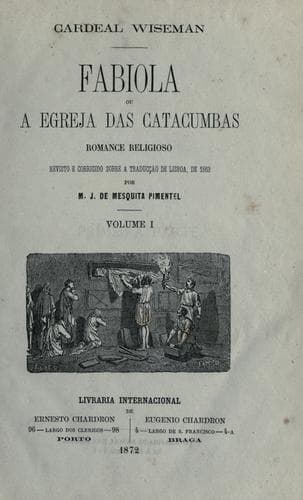
Fabiola; Or, The Church of the CatacombsWiseman, Nicholas Patrick
HistoryHistory
Fabiola; Or, The Church of the Catacombs
Wiseman, Nicholas Patrick
Christian fiction; Church history -- Primitive and early church, ca. 30-600 -- Fiction; Historical fiction
But it is time to return to our other acquaintances in the house of
Fabius.
After Syra had heard the door close on Fulvius she paused to compose
herself, offered up a secret prayer, and returned to her blind friend.
She had finished her frugal meal, and was waiting patiently the slave’s
return. Syra then commenced her daily duties of kindness and
hospitality; she brought water, washed her hands and feet in obedience
to Christian practice, and combed and dressed her hair, as if the poor
creature had been her own child. Indeed, though not much older, her look
was so tender, as she hung over her poor friend, her tones were so soft,
her whole action so motherly, that one would have thought it was a
parent ministering to her daughter, rather than a slave serving a
beggar. And this beggar, too, looked so happy, spoke so cheerily, and
said such beautiful things, that Syra lingered over her work to listen
to her, and gaze on her.
It was at this moment that Agnes came for her appointed interview, and
Fabiola insisted on accompanying her to the door. But when Agnes softly
raised the curtain, and caught a sight of the scene before her, she
beckoned to Fabiola to look in, enjoining silence by her gesture. The
blind girl was opposite, and her voluntary servant on one side,
unconscious of witnesses. The heart of Fabiola was touched; she had
never imagined that there was such a thing as disinterested love on
earth between strangers; as to charity, it was a word unknown to Greece
or Rome. She retreated quietly, with a tear in her eye, and said to
Agnes, as she took leave:
“I must retire; that girl, as you know, proved to me this afternoon that
a slave may have a head; she has now shown me that she may have a heart.
I was amazed, when, a few hours ago, you asked me if I did not love a
slave. I think, now, I could almost love Syra. I half regret that I have
agreed to part with her.”
As she went back into the court, Agnes entered the room, and laughing,
said:
“So, Cæcilia, I have found out your secret at last. This is the friend
whose food you have always said was so much better than mine, that you
would never eat at my house. Well, if the dinner is not better, at any
rate I agree that you have fallen in with a better hostess.”
“Oh, don’t say so, sweet Lady Agnes,” answered the blind girl: “it is
the dinner indeed that is better. You have plenty of opportunities for
exercising charity; but a poor slave can only do so by finding some one
still poorer, and helpless, like me. That thought makes her food by far
the sweetest.”
“Well, you are right,” said Agnes, “and I am not sorry to have you
present, to hear the good news I bring to Syra. It will make _you_ happy
too. Fabiola has allowed me to become your mistress, Syra, and to take
you with me. To-morrow you shall be free, and a dear sister to me.”
Cæcilia clapped her hands with joy, and throwing her arms round Syra’s
neck, exclaimed: “Oh, how good! How happy you will now be, dear Syra!”
Public-domain text, read in full here on John Shaqi.
Reviews
Reviews
No reviews yet
Be the first to share your thoughts on this work.
Elsewhere in the archive
Join the Discussion
Join the discussion
Sign in to leave a comment or review.
Sign InorCreate an account