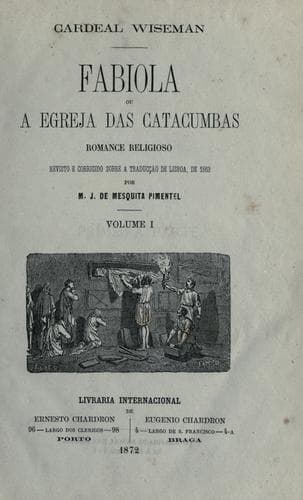
Fabiola; Or, The Church of the CatacombsWiseman, Nicholas Patrick
HistoryHistory
Fabiola; Or, The Church of the Catacombs
Wiseman, Nicholas Patrick
Christian fiction; Church history -- Primitive and early church, ca. 30-600 -- Fiction; Historical fiction
“You have conquered, sister Syra (oh! never again call me lady),” said
Agnes. “Remain at your post; such single-hearted, generous virtue must
triumph. It is too sublime for so homely a sphere as my household.”
“And I, for my part,” subjoined Cæcilia, with a look of arch gravity,
“say that she has said one very wicked thing, and told a great story,
this evening.”
“What is that, my pet?” asked Syra, laughing.
“Why, you said that I was wiser and better than you, because I declined
eating some trumpery delicacy, which would have gratified my palate for
a few minutes, at the expense of an act of greediness; while you have
given up liberty, happiness, the free exercise of your religion, and
have offered to give up life itself, for the salvation of one who is
your tyrant and tormentor. Oh, fie! how could you tell me such a thing!”
[Illustration: A Dove, as a Symbol of the Soul, found in the Catacombs.]
The servant now announced that Agnes’s litter was waiting at the door;
and any one who could have seen the affectionate farewell of the
three,--the noble lady, the slave, and the beggar, would have justly
exclaimed, as people had often done before, “See how these Christians
love one another!”
CHAPTER VIII.
THE FIRST DAY’S CONCLUSION.
If we linger a little time about the door, and see Agnes fairly off, and
listen to the merry conversation between her and Cæcilia, in which Agnes
asks her to allow herself to be accompanied home by one of her
attendants, as it has grown dark, and the girl is amused at the lady’s
forgetfulness that day and night are the same to her, and that on this
very account she is the appointed guide to thread the mazes of the
catacombs, familiar to her as the streets of Rome, which she walks in
safety at all hours; if thus we pass a little time before re-entering,
to inquire how the mistress within fares after the day’s adventures, we
shall find the house turned topsy-turvy. Slaves, with lamps and torches,
are running about in every direction, looking for something or other
that is lost, in every possible and impossible place. Euphrosyne insists
it must be found; till at last the search is given up in despair. The
reader will probably have anticipated the solution of the mystery. Syra
had presented herself to have her wound re-dressed, according to orders,
and the scarf which had bound it was no longer there. She could give no
account of it, further than that she had taken it off, and put it on,
certainly not so well as Euphrosyne had done it, and she gave the
reason, for she scorned to tell a lie. Indeed she had never missed it
till now. The kind-hearted old nurse was much grieved at the loss,
which she considered must be heavy to a poor slave-girl, as she probably
reserved that object for the purchase of her liberty. And Syra too was
sorry, but for reasons which she could not have made the good
housekeeper comprehend.
Public-domain text, read in full here on John Shaqi.
Reviews
Reviews
No reviews yet
Be the first to share your thoughts on this work.
Elsewhere in the archive
Join the Discussion
Join the discussion
Sign in to leave a comment or review.
Sign InorCreate an account