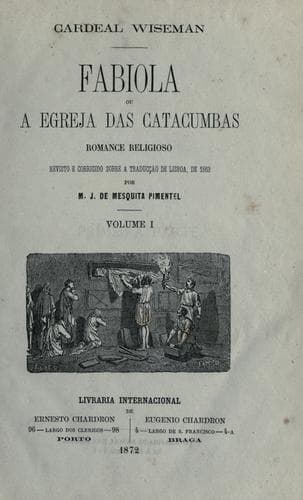
Fabiola; Or, The Church of the CatacombsWiseman, Nicholas Patrick
HistoryHistory
Fabiola; Or, The Church of the Catacombs
Wiseman, Nicholas Patrick
Christian fiction; Church history -- Primitive and early church, ca. 30-600 -- Fiction; Historical fiction
Of all the Roman hills, the most distinctly traceable on every side is
undoubtedly the Palatine. Augustus having chosen it for his residence,
successive emperors followed his example; but gradually transformed his
modest residence into a _palace_, which covered the entire hill. Nero,
not satisfied with its dimensions, destroyed the neighborhood by fire,
and then extended the imperial residence to the neighboring Esquiline;
taking in the whole space now occupied between the two hills by the
Coliseum. Vespasian threw down that “golden house,” of which the
magnificent vaults remain, covered with beautiful paintings; and built
the amphitheatre just mentioned, and other edifices, with its materials.
The entrance to the palace was made, soon after this period, from the
_Via Sacra_, or Sacred Way, close to the arch of Titus. After passing
through a vestibule, the visitor found himself in a magnificent court,
the plan of which can be distinctly traced. Turning from this, on the
left side, he entered into an immense square space, arranged and
consecrated to Adonis by Domitian, and planted with trees, shrubs, and
flowers.
Still keeping to the left, you would enter into sets of chambers,
constructed by Alexander Severus in honor of his
[Illustration: The Ruins of the Coliseum, as seen from the Palatine of
St. Bonaventure.]
mother Mammæa, whose name they bore. They looked out opposite to the
Cœlian hill, just at the angle of it, which abuts upon the later
triumphal arch of Constantine, and the fountain called the _Meta
Sudans_.[36] Here was the apartment occupied by Sebastian as a tribune,
or superior officer, of the imperial guard. It consisted of a few rooms,
most modestly furnished, as became a soldier and a Christian. His
household was limited to a couple of freedmen, and a venerable matron,
who had been his nurse, and loved him as a child. They were Christians,
as were all the men in his cohort; partly by conversion, but chiefly by
care in recruiting new soldiers.
[Illustration: _Meta Sudans_, after a bronze of Vespasian.]
Public-domain text, read in full here on John Shaqi.
Reviews
Reviews
No reviews yet
Be the first to share your thoughts on this work.
Elsewhere in the archive
Join the Discussion
Join the discussion
Sign in to leave a comment or review.
Sign InorCreate an account