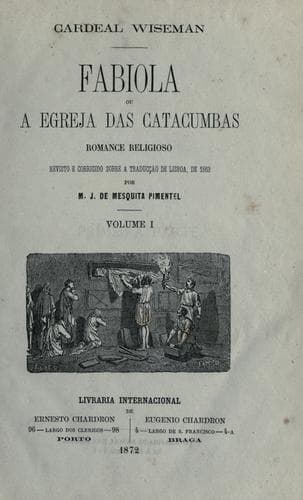
Fabiola; Or, The Church of the CatacombsWiseman, Nicholas Patrick
HistoryHistory
Fabiola; Or, The Church of the Catacombs
Wiseman, Nicholas Patrick
Christian fiction; Church history -- Primitive and early church, ca. 30-600 -- Fiction; Historical fiction
It was a few evenings after the scenes described in the last chapter,
that Sebastian, a couple of hours after dark, ascended the steps of the
vestibule just described, in company with another youth, of whom we have
already spoken. Pancratius admired and loved Sebastian with the sort of
affection that an ardent young officer may be supposed to bear towards
an older and gallant soldier, who receives him into his friendship. But
it was not as to a soldier of Cæsar, but as to a champion of Christ,
that the civilian boy looked up to the young tribune, whose generosity,
noble-mindedness, and valor, were enshrouded in such a gentle, simple
bearing, and were accompanied by such prudence and considerateness, as
gave confidence and encouragement to all that dealt with him. And
Sebastian loved Pancratius no less, on account of his single-hearted
ardor, and the innocence and candor of his mind. But he well saw the
dangers to which his youthful warmth and impetuosity might lead him; and
he encouraged him to keep close to himself, that he might guide, and
perhaps sometimes restrain him.
[Illustration: The Arch of Titus.]
As they were entering the palace, that part of which Sebastian’s cohort
guarded, he said to his companion: “Every time that I enter here, it
strikes me how kind an act of Divine Providence it was, to plant almost
at the very gate of Cæsar’s palace, the arch which commemorates at once
the downfall of the first great system that was antagonistic to
Christianity, and the completion of the greatest prophecy of the
Gospel,--the destruction of Jerusalem by the Roman power.[37] I cannot
but believe that another arch will one day arise to commemorate no less
a victory, over the second enemy of our religion, the heathen Roman
empire itself.”
“What! do you contemplate the overthrow of this vast empire, as the
means of establishing Christianity?”
“God forbid! I would shed the last drop of my blood, as I shed my first,
to maintain it. And depend upon it, when the empire is converted, it
will not be by such gradual growth as we now witness, but by some means,
so unhuman, so divine, as we shall never, in our most sanguine longings,
forecast; but all will exclaim, ‘This is the change of the right hand of
the Most High!’”
“No doubt; but your idea of a Christian triumphal arch supposes an
earthly instrument; where do you imagine this to lie?”
“Why, Pancratius, my thoughts, I own, turn towards the family of one of
the Augusti, as showing a slight germ of better thoughts: I mean,
Constantius Chlorus.”
“But, Sebastian, how many of even our learned and good men will say,
nay, do say, if you speak thus to them, that similar hopes were
entertained in the reigns of Alexander, Gordian, or Aurelian; yet ended
in disappointment. Why, they ask, should we not expect the same results
now?”
Public-domain text, read in full here on John Shaqi.
Reviews
Reviews
No reviews yet
Be the first to share your thoughts on this work.
Elsewhere in the archive
Join the Discussion
Join the discussion
Sign in to leave a comment or review.
Sign InorCreate an account