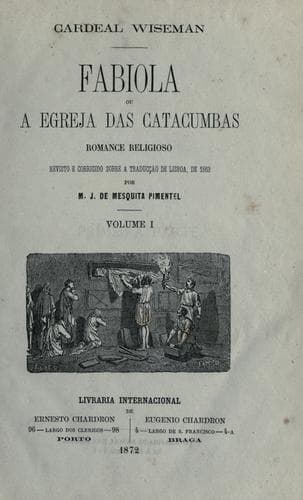
Fabiola; Or, The Church of the CatacombsWiseman, Nicholas Patrick
HistoryHistory
Fabiola; Or, The Church of the Catacombs
Wiseman, Nicholas Patrick
Christian fiction; Church history -- Primitive and early church, ca. 30-600 -- Fiction; Historical fiction
“Well, then, Sebastian--now don’t think me foolish,” proceeded
Pancratius, hesitating and blushing at every word. “You are aware I have
a quantity of useless plate at home--mere lumber, you know, in our plain
way of living; and my dear mother, for any thing I can say, won’t wear
the lots of old-fashioned trinkets, which are lying locked up, and of no
use to any body. I have no one to whom all this should descend. I am,
and shall be, the last of my race. You have often told me, who in that
case are a Christian’s natural heirs,--the widow and the fatherless, the
helpless and the indigent. Why should these wait my death, to have what
by reversion is theirs? And if a persecution is coming, why run the
risk of confiscation seizing them, or of plundering lictors stealing
them, whenever our lives are wanted, to the utter loss of our rightful
heirs?”
“Pancratius,” said Sebastian, “I have listened without offering a remark
to your noble suggestion. I wished you to have all the merit of uttering
it yourself. Now, just tell me, what makes you doubt or hesitate about
what I know you wish to do?”
“Why, to tell the truth, I feared it might be highly presumptuous and
impertinent in one of my age to offer to do what people would be sure to
imagine was something grand or generous; while I assure you, dear
Sebastian, it is no such thing. For I shall not miss these things a bit;
they are of no value to me whatever. But they will be to the poor,
especially in the hard times coming.”
“Of course Lucina consents?”
“Oh, no fear about that! I would not touch a grain of gold-dust without
her even wishing it. But why I require your assistance is principally
this. I should never be able to stand its being known that I presumed to
do any thing considered out of the way, especially in a boy. You
understand me? So I want you, and beg of you, to get the distribution
made at some other house; and as from a--say from one who needs much the
prayers of the faithful, especially the poor, and desires to remain
unknown.”
“I will serve you with delight, my good and truly noble boy! Hush! did
you not hear the Lady Fabiola’s name just mentioned? There again, and
with an epithet expressive of no good will.”
Pancratius approached the window; two voices were conversing together so
close under them that the cornice between prevented their seeing the
speakers, evidently a woman and a man. After a few minutes they walked
out into the moonlight, almost as bright as day.
“I know that Moorish woman,” said Sebastian; “it is Fabiola’s black
slave, Afra.”
“And the man,” added Pancratius, “is my late school-fellow, Corvinus.”
They considered it their duty to catch, if possible, the thread of what
seemed a plot; but, as the speakers walked up and down, they could only
make out a sentence here and there. We will not, however, confine
ourselves to these parts, but give the entire dialogue. Only, a word
first about the interlocutors.
Public-domain text, read in full here on John Shaqi.
Reviews
Reviews
No reviews yet
Be the first to share your thoughts on this work.
Elsewhere in the archive
Join the Discussion
Join the discussion
Sign in to leave a comment or review.
Sign InorCreate an account