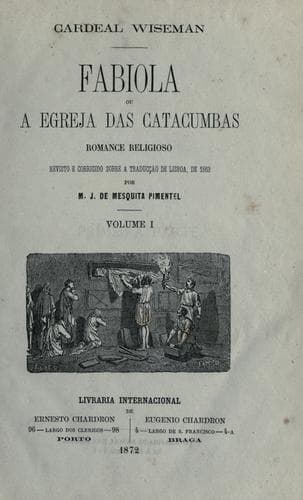
Fabiola; Or, The Church of the CatacombsWiseman, Nicholas Patrick
HistoryHistory
Fabiola; Or, The Church of the Catacombs
Wiseman, Nicholas Patrick
Christian fiction; Church history -- Primitive and early church, ca. 30-600 -- Fiction; Historical fiction
Of the slave we know enough for the present. Corvinus was son, as we
have said, to Tertullus, originally prefect of the Prætorium. This
office, unknown in the republic, and of imperial creation, had, from the
reign of Tiberius, gradually absorbed almost all civil as well as
military power; and he who held it often discharged the duties of chief
criminal judge in Rome. It required no little strength of nerve to
occupy this post to the satisfaction of despotic and unsparing masters.
To sit all day in a tribunal, surrounded with hideous implements of
torture, unmoved by the moans or the shrieks of old men, youths, or
women, on whom they were tried; to direct a cool interrogatory to one
stretched upon the rack, and quivering in agony on one side, while the
last sentence of beating to death with bullet-laden scourges was being
executed on the other; to sleep calmly after such scenes, and rise with
appetite for their repetition, was not an occupation to which every
member of the bar could be supposed to aspire. Tertullus had been
brought from Sicily to fill the office, not because he was a cruel, but
because he was a cold-hearted, man, not susceptible of pity or
partiality. His tribunal, however, was Corvinus’s early school; he could
sit, while quite a boy, for hours at his father’s feet, thoroughly
enjoying the cruel spectacles before him, and angry when any one got
off. He grew up sottish, coarse, and brutal; and not yet arrived at
man’s estate, his bloated and freckled countenance and blear eyes, one
of which was half closed, announced him to be already a dissolute and
dissipated character. Without taste for any thing refined, or ability
for any learning, he united in himself a certain amount of animal
courage and strength, and a considerable measure of low cunning. He had
never experienced in himself a generous feeling, and he had never curbed
an evil passion. No one had ever offended him, whom he did not hate, and
pursue with vengeance. Two, above all, he had sworn never to
forgive--the school-master who had often chastised him for his sulky
idleness, and the school-fellow who had blessed him for his brutal
contumely. Justice and mercy, good and evil done to him, were equally
odious to him.
Tertullus had no fortune to give him, and he seemed to have little
genius to make one. To become possessed of one, however, was
all-important to his mind; for wealth, as the means of gratifying his
desires, was synonymous with him to supreme felicity. A rich heiress, or
rather her dower, seemed the simplest object at which to aim. Too
awkward, shy, and stupid to make himself a way in society, he sought
other means, more kindred to his mind, for the attainment of his
ambitious or avaricious desires. What these means were, his conversation
with the black slave will best explain.
“I have come to meet you at the Meta Sudans again, for the fourth time,
at this inconvenient hour. What news have you for me?”
Public-domain text, read in full here on John Shaqi.
Reviews
Reviews
No reviews yet
Be the first to share your thoughts on this work.
Elsewhere in the archive
Join the Discussion
Join the discussion
Sign in to leave a comment or review.
Sign InorCreate an account