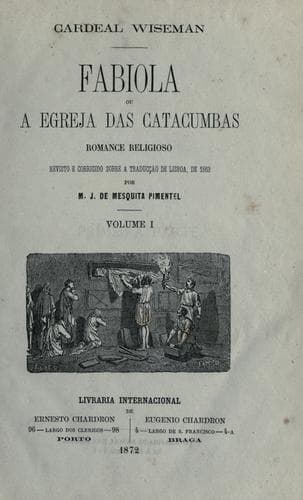
Fabiola; Or, The Church of the CatacombsWiseman, Nicholas Patrick
HistoryHistory
Fabiola; Or, The Church of the Catacombs
Wiseman, Nicholas Patrick
Christian fiction; Church history -- Primitive and early church, ca. 30-600 -- Fiction; Historical fiction
Sebastian, after bidding affectionate farewell to his friends, insisted
upon accompanying Pancratius home. As they were leaving the room, the
latter remarked, “Sebastian, I do not like that Torquatus. I fear he
will give us trouble.”
“To tell the truth,” answered the soldier, “I would rather he were
different; but we must remember that he is a neophyte, and will improve
in time, and by grace.”
As they passed into the entrance-court of the palace, they heard a Babel
of uncouth sounds, with coarse laughter and occasional yells, proceeding
from the adjoining yard, in which were the quarters of the Mauritanian
archers. A fire seemed to be blazing in the midst of it, for the smoke
and sparks rose above the surrounding porticoes.
Sebastian accosted the sentinel in the court where they were, and asked:
“Friend, what is going on there among our neighbors?”
“The black slave,” he replied, “who is their priestess, and who is
betrothed to their captain, if she can purchase her freedom, has come in
for some midnight rites, and this horrid turmoil takes place every time
she comes.”
“Indeed!” said Pancratius, “and can you tell me what is the religion
these Africans follow?”
“I do not know, sir,” replied the legionary, “unless they be what are
called Christians.”
“What makes you think so?”
“Why, I have heard that the Christians meet by night, and sing
detestable songs, and commit all sorts of crimes; and cook and eat the
flesh of a child murdered for the purpose[43]--just what might seem to
be going on here.”
“Good night, comrade,” said Sebastian; and then exclaimed, as they were
issuing from the vestibule, “Is it not strange, Pancratius, that, in
spite of all our efforts, we who are conscious that we worship only the
One living God in spirit and truth, who know what care we take to keep
ourselves undefiled by sin, and who would die rather than speak an
unclean word, should yet, after 300 years, be confounded by the people
with the followers of the most degraded superstitions, and have our
worship ranked with the very idolatry, which above all things we abhor?
‘How long, O Lord! how long?’”
“So long,” said Pancratius, pausing on the steps outside the vestibule,
and looking at the now declining moon, “so long as we shall continue to
walk in this pale light, and until the Sun of Justice shall rise upon
our country in His beauty, and enrich it with His splendor. Sebastian,
tell me, whence do you best like to see the sun rise?”
Public-domain text, read in full here on John Shaqi.
Reviews
Reviews
No reviews yet
Be the first to share your thoughts on this work.
Elsewhere in the archive
Join the Discussion
Join the discussion
Sign in to leave a comment or review.
Sign InorCreate an account