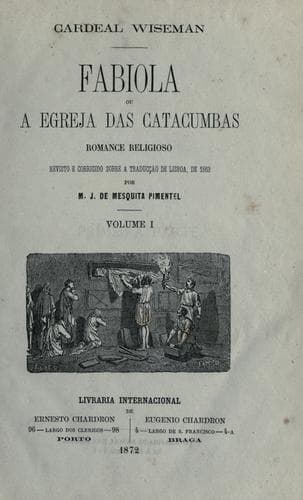
Fabiola; Or, The Church of the CatacombsWiseman, Nicholas Patrick
HistoryHistory
Fabiola; Or, The Church of the Catacombs
Wiseman, Nicholas Patrick
Christian fiction; Church history -- Primitive and early church, ca. 30-600 -- Fiction; Historical fiction
“The most lovely sunrise I have ever seen,” replied the soldier, as if
humoring his companion’s fanciful question, “was from the top of the
Latial mountain,[44] by the temple of Jupiter. The sun rose behind the
mountain, and projected its huge shadow like a pyramid over the plain,
and far upon the sea; then, as it rose higher, this lessened and
withdrew; and every moment some new object caught the light, first the
galleys and skiffs upon the water, then the shore with its dancing
waves; and by degrees one white edifice after the other sparkled in the
fresh beams, till at last majestic Rome itself, with its towering
pinnacles, basked in the effulgence of day. It was a glorious sight,
indeed; such as could not have been witnessed or imagined by those
below.”
“Just what I should have expected, Sebastian,” observed Pancratius; “and
so it will be when that more brilliant sun rises fully upon this
benighted country. How beautiful will it then be to behold the shades
retiring, and each moment one and another of the charms, as yet
concealed, of our holy faith and worship starting into light, till the
imperial city itself shines forth a holy type of the city of God. Will
they who live in those times see these beauties, and worthily value
them? Or, will they look only at the narrow space around them, and hold
their hands before their eyes, to shade them from the sudden glare? I
know not, dear Sebastian, but I hope that you and I will look down upon
that grand spectacle, from where alone it can be duly appreciated, from
a mountain higher than Jupiter’s, be he Alban or be he
Olympian,--dwelling on that holy mount, whereon stands the Lamb, from
whose feet flow the streams of life.”[45]
They continued their walk in silence through the brilliantly-lighted
streets;[46] and when they had reached Lucina’s house, and had
affectionately bid one another good-night, Pancratius seemed to hesitate
a moment, and then said:
“Sebastian, you said something this evening, which I should much like to
have explained.”
“What was it?”
“When you were contending with Polycarp, about going into Campania, or
remaining in Rome, you promised that if you stayed you would be most
cautious, and not expose yourself to unnecessary risks; then you added,
that there was one purpose in your mind which would effectually restrain
you; but that when that was accomplished, you would find it difficult to
check your longing ardor to give your life for Christ.”
“And why, Pancratius, do you desire so much to know this foolish thought
of mine?”
“Because I own I am really curious to learn what can be the object high
enough to check in you the aspiration, after what I know you consider to
be the very highest of a Christian’s aim.”
“I am sorry, my dear boy, that it is not in my power to tell you now.
But you shall know it sometime.”
“Do you promise me?”
“Yes, most solemnly. God bless you!”
[Illustration: A Lamb with a Milk-can, found in the Catacomb of SS.
Peter and Marcellin.]
Public-domain text, read in full here on John Shaqi.
Reviews
Reviews
No reviews yet
Be the first to share your thoughts on this work.
Elsewhere in the archive
Join the Discussion
Join the discussion
Sign in to leave a comment or review.
Sign InorCreate an account