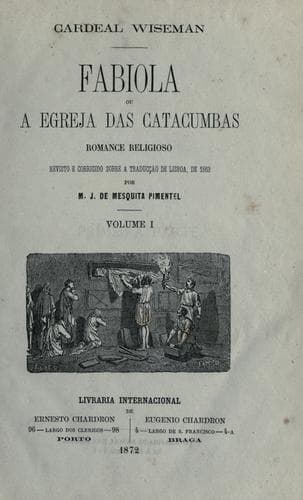
Fabiola; Or, The Church of the CatacombsWiseman, Nicholas Patrick
HistoryHistory
Fabiola; Or, The Church of the Catacombs
Wiseman, Nicholas Patrick
Christian fiction; Church history -- Primitive and early church, ca. 30-600 -- Fiction; Historical fiction
CHAPTER XI.
A TALK WITH THE READER.
We will take advantage of the holiday which Rome is enjoying, sending
out its inhabitants to the neighboring hills, or to the whole line of
sea-coast from Genoa to Pæstum, for amusement on land and water: and, in
a merely didactic way, endeavor to communicate to our reader some
information, which may throw light on what we have already written, and
prepare him for what will follow.
From the very compressed form in which the early history of the Church
is generally studied, and from the unchronological arrangement of the
saints’ biographies, as we usually read them, we may easily be led to an
erroneous idea of the state of our first Christian ancestors. This may
happen in two different ways.
We may come to imagine, that during the first three centuries the Church
was suffering unrespited, under active persecution; that the faithful
worshipped in fear and trembling, and almost lived in the catacombs;
that bare existence, with scarcely an opportunity for outward
development or inward organization, none for splendor, was all that
religion could enjoy; that, in fine, it was a period of conflict and of
tribulation, without an interval of peace or consolation. On the other
hand, we may suppose, that those three centuries were divided into
epochs by ten distinct persecutions, some of longer and some of shorter
duration, but definitely separated from one another by breathing times
of complete rest.
Either of these views is erroneous; and we desire to state more
accurately the real condition of the Christian Church, under the various
circumstances of that most pregnant portion of her history.
When once persecution had broken loose upon the Church, it may be said
never entirely to have relaxed its hold, till her final pacification
under Constantine. An edict of persecution once issued by an emperor was
seldom recalled; and though the rigor of its enforcement might gradually
relax or cease, through the accession of a milder ruler, still it never
became completely a dead letter, but was a dangerous weapon in the hands
of a cruel or bigoted governor of a city or province. Hence, in the
intervals between the greater general persecutions, ordered by a new
decree, we find many martyrs, who owed their crowns either to popular
fury, or to the hatred of Christianity in local rulers. Hence also we
read of a bitter persecution being carried on in one part of the empire,
while other portions enjoyed complete peace.
Perhaps a few examples of the various phases of persecution will
illustrate the real relations of the primitive Church with the State,
better than mere description; and the more learned reader can pass over
this digression, or must have the patience to hear repeated, what he is
so familiar with, that it will seem commonplace.
Public-domain text, read in full here on John Shaqi.
Reviews
Reviews
No reviews yet
Be the first to share your thoughts on this work.
Elsewhere in the archive
Join the Discussion
Join the discussion
Sign in to leave a comment or review.
Sign InorCreate an account