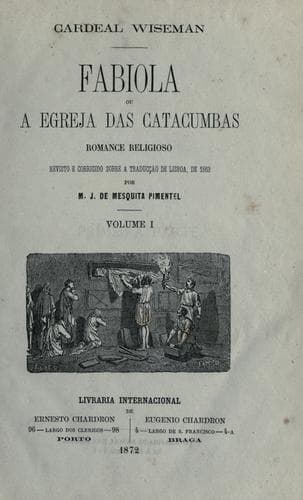
Fabiola; Or, The Church of the CatacombsWiseman, Nicholas Patrick
HistoryHistory
Fabiola; Or, The Church of the Catacombs
Wiseman, Nicholas Patrick
Christian fiction; Church history -- Primitive and early church, ca. 30-600 -- Fiction; Historical fiction
He then goes on to inform him, that he may very well fulfil his duties
without practising cruelty, by acting as other magistrates had done.
For instance, Cincius Severus suggested to the accused the answers they
should make, to be acquitted. Vespronius Candidus dismissed a Christian,
on the ground that his condemnation would encourage tumults. Asper,
seeing one ready to yield upon the application of slight torments, would
not press him further; and expressed regret that such a case should have
been brought before him. Pudens, on reading an act of accusation,
declared the title informal, because calumnious, and tore it up.
We thus see how much might depend upon the temper, and perhaps the
tendencies, of governors and judges, in the enforcing even of imperial
edicts of persecution. And St. Ambrose tells us that some governors
boasted that they had brought back from their provinces their swords
unstained with blood (_incruentos enses_).
We can also easily understand how, at any particular time, a savage
persecution might rage in Gaul, or Africa, or Asia, while the main part
of the Church was enjoying peace. But Rome was undoubtedly the place
most subject to frequent outbreaks of the hostile spirit; so that it
might be considered as the privilege of its pontiffs, during the first
three centuries, to bear the witness of blood to the faith which they
taught. To be elected Pope was equivalent to being promoted to
martyrdom.
At the period of our narrative, the Church was in one of those longer
intervals of comparative peace, which gave opportunity for great
development. From the death of Valerian, in 268, there had been no new
formal persecution, though the interval is glorified by many noble
martyrdoms. During such periods, the Christians were able to carry out
their religious system with completeness, and even with splendor. The
city was divided into districts or parishes, each having its title, or
church, served by priests, deacons, and inferior ministers. The poor
were supported, the sick visited, catechumens instructed; the
Sacraments were administered, daily worship was practised, and the
penitential canons were enforced by the clergy of each title; and
collections were made for these purposes, and others connected with
religious charity, and its consequence, hospitality. It is recorded,
that in 250, during the pontificate of Cornelius, there were in Rome
forty-six priests, a hundred and fifty-four inferior ministers, who were
supported by the alms of the faithful, together with fifteen hundred
poor.[48] This number of the priests pretty nearly corresponds to that
of the titles, which St. Optatus tells us there were in Rome.
Public-domain text, read in full here on John Shaqi.
Reviews
Reviews
No reviews yet
Be the first to share your thoughts on this work.
Elsewhere in the archive
Join the Discussion
Join the discussion
Sign in to leave a comment or review.
Sign InorCreate an account