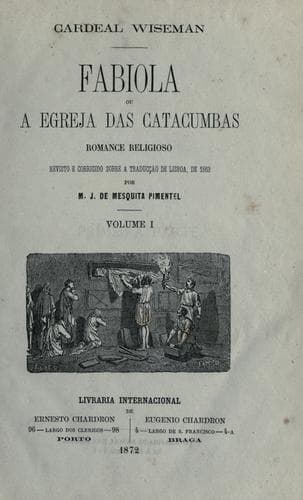
Fabiola; Or, The Church of the CatacombsWiseman, Nicholas Patrick
HistoryHistory
Fabiola; Or, The Church of the Catacombs
Wiseman, Nicholas Patrick
Christian fiction; Church history -- Primitive and early church, ca. 30-600 -- Fiction; Historical fiction
Although the tombs of the martyrs in the catacombs continued to be
objects of devotion during these more peaceful intervals, and these
asylums of the persecuted were kept in order and repair, they did not
then serve for the ordinary places of worship. The churches to which we
have already alluded were often public, large, and even splendid; and
heathens used to be present at the sermons delivered in them, and such
portions of the liturgy as were open to catechumens. But generally they
were in private houses, probably made out of the large halls, or
_triclinia_, which the nobler mansions contained. Thus we know that many
of the titles in Rome were originally of that character. Tertullian
mentions Christian cemeteries under a name, and with circumstances,
which show that they were above ground, for he compares them to
“threshing-floors,” which were necessarily exposed to the air.
A custom of ancient Roman life will remove an objection which may arise,
as to how considerable multitudes could assemble in these places without
attracting attention, and consequently persecution. It was usual for
what may be called a levée to be held every morning by the rich,
attended by dependents, or clients, and messengers from their friends,
either slaves or freedmen, some of whom were admitted into
[Illustration: The Sacrament of Penance, in the Early Ages of the
Church.]
the inner court, to the master’s presence, while others only presented
themselves, and were dismissed. Hundreds might thus go in and out of a
great house, in addition to the crowd of domestic slaves, tradespeople
and others who had access to it, through the principal or the back
entrance, and little or no notice would be taken of the circumstance.
There is another important phenomenon in the social life of the early
Christians, which one would hardly know how to believe, were not
evidence of it brought before us in the most authentic Acts of the
martyrs, and in ecclesiastical history. It is, the concealment which
they contrived to practise. No doubt can be entertained, that persons
were moving in the highest society, were occupying conspicuous public
situations, were near the persons of the emperors, who were Christians;
and yet were not suspected to be such by their most intimate heathen
friends. Nay, cases occurred where the nearest relations were kept in
total ignorance on this subject. No lie, no dissembling, no action
especially, inconsistent with Christian morality or Christian truth, was
ever permitted to ensure such secrecy. But every precaution compatible
with complete uprightness was taken to conceal Christianity from the
public eye.[49]
Public-domain text, read in full here on John Shaqi.
Reviews
Reviews
No reviews yet
Be the first to share your thoughts on this work.
Elsewhere in the archive
Join the Discussion
Join the discussion
Sign in to leave a comment or review.
Sign InorCreate an account