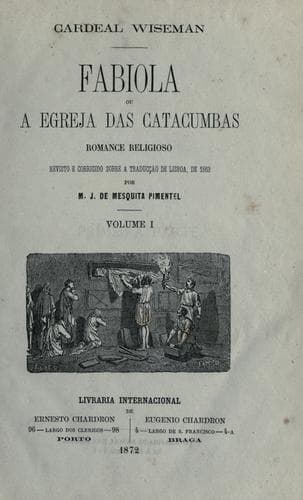
Fabiola; Or, The Church of the CatacombsWiseman, Nicholas Patrick
HistoryHistory
Fabiola; Or, The Church of the Catacombs
Wiseman, Nicholas Patrick
Christian fiction; Church history -- Primitive and early church, ca. 30-600 -- Fiction; Historical fiction
Rooms were set apart for lodging strangers who came from a distance,
recommended by other churches; and a frugal table was provided for them.
Upstairs were apartments for an hospital for the bed-ridden, the
decrepit, and the sick, under the care of the deaconesses, and such of
the faithful as loved to assist in this work of charity. It was here
that the blind girl had her cell, though she refused to take her food,
as we have seen, in the house. The _tablinum_, or muniment-room, which
generally stood detached in the middle of the passage between the inner
courts, served as the office and archives for transacting the business
of this charitable establishment, and preserving all local documents,
such as the acts of martyrs, procured or compiled by the one of the
seven notaries kept for that purpose, by institution of St. Clement I.,
who was attached to that region.
A door of communication allowed the household to assist in these works
of charity; and Agnes had been accustomed from childhood to run in and
out, many times a day, and to pass hours there; always beaming, like an
angel of light, consolation and joy on the suffering and distressed.
This house, then, might be called the almonry of the region, or
district, of charity and hospitality in which it was situated, and it
was accessible for these purposes through the _posticum_ or back door,
situated in a narrow lane little frequented. No wonder that with such an
establishment, the fortune of the inmates should find an easy
application.
We heard Pancratius request Sebastian, to arrange for the distribution
of his plate and jewels among the poor, without its being known to whom
they belonged. He had not lost sight of the commission, and had fixed on
the house of Agnes as the fittest for this purpose. On the morning which
we have described the distribution had to take place; other regions had
sent their poor, accompanied by their deacons; while Sebastian,
Pancratius, and other persons of higher rank had come in through the
front door, to assist in the division. Some of these had been seen to
enter by Corvinus.
[Illustration: A Fish carrying Bread and Wine, from the Cemetery of St.
Lucina.]
CHAPTER XIV.
EXTREMES MEET.
A group of poor coming opportunely towards the door, enabled Corvinus to
tack himself to them,--an admirable counterfeit, in all but the modesty
of their deportment. He kept sufficiently close to them to hear that
each of them, as he entered in, pronounced the words, “_Deo gratias_,”
“Thanks be to God.” This was not merely a Christian, but a Catholic
pass-word; for St. Augustine tells us that heretics ridiculed Catholics
for using it, on the ground that it was not a salutation but rather a
reply; but that Catholics employed it, because consecrated by pious
usage. It is yet heard in Italy on similar occasions.
Public-domain text, read in full here on John Shaqi.
Reviews
Reviews
No reviews yet
Be the first to share your thoughts on this work.
Elsewhere in the archive
Join the Discussion
Join the discussion
Sign in to leave a comment or review.
Sign InorCreate an account