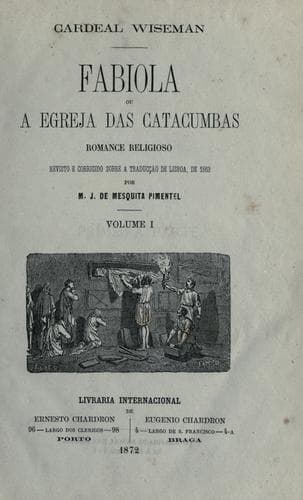
Fabiola; Or, The Church of the CatacombsWiseman, Nicholas Patrick
HistoryHistory
Fabiola; Or, The Church of the Catacombs
Wiseman, Nicholas Patrick
Christian fiction; Church history -- Primitive and early church, ca. 30-600 -- Fiction; Historical fiction
Corvinus pronounced the mystic words, and was allowed to pass. Following
the others closely, and copying their manners and gestures, he found
himself in the inner court of the house, which was already filled with
the poor and infirm. The men were ranged on one side, the women on the
other. Under the portico at the end were tables piled with costly plate,
and near them was another covered with brilliant jewelry. Two silver and
goldsmiths were weighing and valuing most conscientiously this property;
and beside them was the money which they would give, to be distributed
amongst the poor, in just proportion.
Corvinus eyed all this with a gluttonous heart. He would have given
anything to get it all, and almost thought of making a dash at
something, and running out. But he saw at once the folly or madness of
such a course, and resolved to wait for a share, and in the meantime
take note for Fulvius of all he saw. He soon, however, became aware of
the awkwardness of his present position. While the poor were all mixed
up together and moving about, he remained unnoticed. But he soon saw
several young men of peculiarly gentle manners, but active, and
evidently in authority, dressed in the garment known to him by the name
of Dalmatic, from its Dalmatian origin; that is, having over the tunic,
instead of the toga, a close-fitting shorter tunicle, with ample, but
not over long or wide sleeves; the dress adopted and worn by the
deacons, not only at their more solemn ministrations in church, but also
when engaged in the discharge of their secondary duties about the sick
and poor.
These officers went on marshalling the attendants, each evidently
knowing those of his own district, and conducting them to a peculiar
spot within the porticoes. But as no one recognized or claimed Corvinus
for one of his poor, he was at length left alone in the middle of the
court. Even his dull mind could feel the anomalous situation into which
he had thrust himself. Here he was, the son of the prefect of the city,
whose duty it was to punish such violators of domestic rights, an
intruder into the innermost parts of a nobleman’s house, having entered
by a cheat, dressed like a beggar, and associating himself with such
people, of course for some sinister, or at least unlawful, purpose. He
looked towards the door, meditating an escape; but he saw it guarded by
an old man named Diogenes and his two stout sons, who could hardly
restrain their hot blood at this insolence, though they only showed it
by scowling looks, and repressive biting of their lips. He saw that he
was a subject of consultation among the young deacons, who cast
occasional glances towards him; he imagined that even the blind were
staring at him, and the decrepit ready to wield their crutches like
battle-axes against him. He had only one consolation; it was evident he
was not known, and he hoped to frame some excuse for getting out of the
scrape.
Public-domain text, read in full here on John Shaqi.
Reviews
Reviews
No reviews yet
Be the first to share your thoughts on this work.
Elsewhere in the archive
Join the Discussion
Join the discussion
Sign in to leave a comment or review.
Sign InorCreate an account