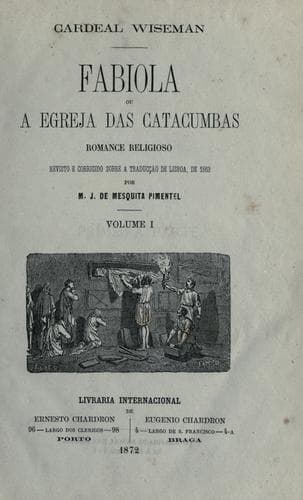
Fabiola; Or, The Church of the CatacombsWiseman, Nicholas Patrick
HistoryHistory
Fabiola; Or, The Church of the Catacombs
Wiseman, Nicholas Patrick
Christian fiction; Church history -- Primitive and early church, ca. 30-600 -- Fiction; Historical fiction
At length the Deacon Reparatus came up to him, and thus courteously
accosted him:
“Friend, you probably do not belong to one of the regions invited here
to-day. Where do you live?”
“In the region of the Alta Semita.”[55]
This answer gave the civil, not the ecclesiastical, division of Rome;
still Reparatus went on: “The Alta Semita is in my region, yet I do not
remember to have seen you.”
While he spoke these words, he was astonished to see the stranger turn
deadly pale, and totter as if about to fall, while his eyes were fixed
upon the door of communication with the dwelling-house. Reparatus looked
in the same direction, and saw Pancratius, just entered, and gathering
some hasty information from Secundus. Corvinus’s last hope was gone. He
stood the next moment confronted with the youth (who asked Reparatus to
retire), much in the same position as they had last met in, only that,
instead of a circle round him of applauders and backers, he was here
hemmed in on all sides by a multitude who evidently looked with
preference upon his rival. Nor could Corvinus help observing the
graceful development and manly bearing, which a few weeks had given his
late school-mate. He expected a volley of keen reproach, and, perhaps,
such chastisement as he would himself have inflicted in similar
circumstances. What was his amazement when Pancratius thus addressed him
in the mildest tone:
“Corvinus, are you really reduced to distress and lamed by some
accident? Or how have you left your father’s house?”
“Not quite come to that yet, I hope,” replied the bully, encouraged to
insolence by the gentle address, “though, no doubt, you would be
heartily glad to see it.”
“By no means, I assure you; I hold you no grudge. If, therefore, you
require relief, tell me; and though it is not right that you should be
here, I can take you into a private chamber where you can receive it
unknown.”
“Then I will tell you the truth: I came in here merely for a freak; and
I should be glad if you could get me quietly out.”
“Corvinus,” said the youth, with some sternness, “this is a serious
offence. What would your father say, if I desired these young men, who
would instantly obey, to take you as you are, barefoot, clothed as a
slave, counterfeiting a cripple, into the Forum before his tribunal, and
publicly charge you with what every Roman would resent, forcing your way
into the heart of a patrician’s house?”
“For the gods’ sakes, good Pancratius, do not inflict such frightful
punishment.”
“You know, Corvinus, that your own father would be obliged to act
towards you the part of Junius Brutus, or forfeit his office.”
“I entreat you by all that you love, by all that you hold sacred, not to
dishonor me and mine so cruelly. My father and his house, not I, would
be crushed and ruined for ever. I will go on my knees and beg your
pardon for my former injuries, if you will only be merciful.”
Public-domain text, read in full here on John Shaqi.
Reviews
Reviews
No reviews yet
Be the first to share your thoughts on this work.
Elsewhere in the archive
Join the Discussion
Join the discussion
Sign in to leave a comment or review.
Sign InorCreate an account