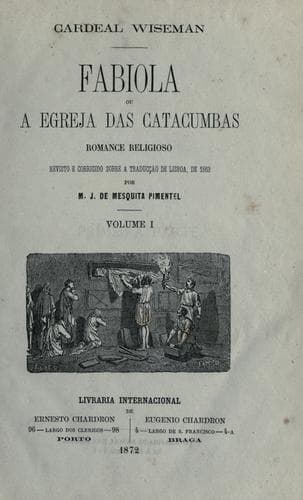
Fabiola; Or, The Church of the CatacombsWiseman, Nicholas Patrick
HistoryHistory
Fabiola; Or, The Church of the Catacombs
Wiseman, Nicholas Patrick
Christian fiction; Church history -- Primitive and early church, ca. 30-600 -- Fiction; Historical fiction
Nor would the great principles be forgotten, of making the light of
good works to shine before men, while the hand which filled the lamp,
poured in its oil in the secret, which only He who seeth in secret can
penetrate. The plate and jewels of a noble family publicly valued, sold,
and, in their price, distributed to the poor, must have been a bright
example of charity, which consoled the Church, animated the generous,
shamed the avaricious, touched the heart of the catechumen, and drew
blessings and prayers from the lips of the poor. And yet the individual
right hand that gave them remained closely shrouded from the scrutiny or
consciousness of the left; and the humility and modesty of the noble
giver remained concealed in His bosom, into which these earthly
treasures were laid up, to be returned with boundless and eternal usury.
And such was the case in the instance before us. When all was prepared,
Dionysius the priest, who at the same time was the physician to whom the
care of the sick was committed, and who had succeeded Polycarp in the
title of St. Pastor, made his appearance, and seated in a chair at one
end of the court, thus addressed the assembly:
“Dear brethren, our merciful God has touched the heart of some
charitable brother, to have compassion on his poorer brethren, and strip
himself of much worldly possession, for Christ’s sake. Who he is I know
not; nor would I seek to know. He is some one who loves not to have his
treasures where rust consumes, and thieves break in and steal, but
prefers, like the blessed Laurence, that they should be borne up, by the
hands of Christ’s poor, into the heavenly treasury.
“Accept then, as a gift from God, who has inspired this charity, the
distribution which is about to be made, and which may be a useful help,
in the days of tribulation which are preparing for us. And as the only
return which is desired from you, join all in that familiar prayer which
we daily recite for those who give, or do us good.”
During this brief address poor Pancratius knew not which
[Illustration: St. Laurence displaying his Treasures.]
way to look. He had shrunk into a corner behind the assistants, and
Sebastian had compassionately stood before him, making himself as large
as possible. And his emotion did all but betray him, when the whole of
that assembly knelt down, and with outstretched hands, uplifted eyes,
and fervent tone, cried out, as if with one voice:
“_Retribuere dignare, Domine, omnibus nobis bona facientibus, propter
Nomen tuum, vitam æternam. Amen._”[59]
The alms were then distributed, and they proved unexpectedly large.
Abundant food was also served out to all, and a cheerful banquet closed
the edifying scene. It was yet early: indeed many partook not of food,
as a still more delicious, and spiritual, feast was about to be prepared
for them in the neighboring titular church.
Public-domain text, read in full here on John Shaqi.
Reviews
Reviews
No reviews yet
Be the first to share your thoughts on this work.
Elsewhere in the archive
Join the Discussion
Join the discussion
Sign in to leave a comment or review.
Sign InorCreate an account