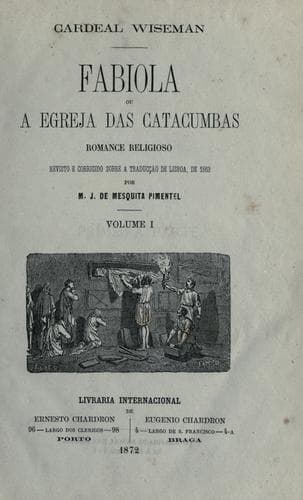
Fabiola; Or, The Church of the CatacombsWiseman, Nicholas Patrick
HistoryHistory
Fabiola; Or, The Church of the Catacombs
Wiseman, Nicholas Patrick
Christian fiction; Church history -- Primitive and early church, ca. 30-600 -- Fiction; Historical fiction
But he had no sooner let go his grasp, than he felt himself seized from
behind by an unseen, but evidently an athletic, assailant. It was
Eurotas, from whom Fulvius durst conceal nothing, and to whom he had
confided the intended interview with Corvinus, that had followed and
watched him. From the black slave he had before learnt the mean and
coarse character of this client of her magical arts; and he feared some
trap. When he saw the seeming struggle at the door, he ran stealthily
behind Sebastian, who, he fancied, must be his pupil’s new ally, and
pounced upon him with a bear’s rude assault. But he had no common rival
to deal with. He attempted in vain, though now helped by Fulvius, to
throw the soldier heavily down; till, despairing of success in this way,
he detached from his girdle a small but deadly weapon, a steel mace of
finished Syrian make, and was raising it over the back of Sebastian’s
head, when he felt it wrenched in a trice from his hand, and himself
twirled two or three times round, in an iron gripe, and flung flat in
the middle of the street.
“I am afraid you have hurt the poor fellow, Quadratus,” said Sebastian
to his centurion, who was coming up at that moment to join his
fellow-Christians, and was of most Herculean make and strength.
“He well deserves it, tribune, for his cowardly assault,” replied the
other, as they re-entered the house.
The two foreigners, crest-fallen, slunk away from the scene of their
defeat; and as they turned the corner, caught a glimpse of Corvinus, no
longer limping, but running as fast as his legs would carry him, from
his discomfiture at the back-door. However often they may have met
afterwards, neither ever alluded to their feats of that morning. Each
knew that the other had incurred only failure and shame; and they came
both to the conclusion, that there was one fold at least in Rome, which
either fox or wolf would assail in vain.
[Illustration: A wall painting from the Cemetery of St. Priscilla.]
CHAPTER XV.
CHARITY RETURNS.
When calm had been restored, after this twofold disturbance, the work of
the day went quietly on. Besides the distribution of greater alms, such
as was made by St. Laurence, from the Church, it was by no means so
uncommon in early ages, for fortunes to be given away at once, by those
who wished to retire from the world.[57] Indeed we should naturally
expect to find that the noble charity of the Apostolic Church at
Jerusalem would not be a barren example to that of Rome. But this
extraordinary charity would be most naturally suggested at periods when
the Church was threatened with persecution; and when Christians, who
from position and circumstances might look forward to martyrdom, would,
to use a homely phrase, clear their hearts and houses for action, by
removing from both whatever could attach themselves to earth, and become
the spoil of the impious soldier, instead of having been made the
inheritance of the poor.[58]
Public-domain text, read in full here on John Shaqi.
Reviews
Reviews
No reviews yet
Be the first to share your thoughts on this work.
Elsewhere in the archive
Join the Discussion
Join the discussion
Sign in to leave a comment or review.
Sign InorCreate an account