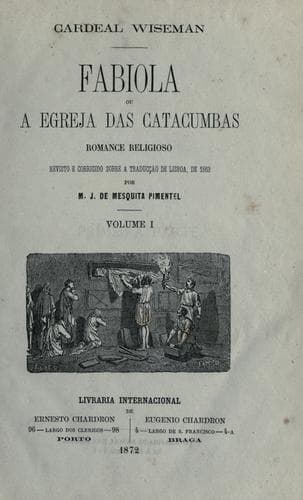
Fabiola; Or, The Church of the CatacombsWiseman, Nicholas Patrick
HistoryHistory
Fabiola; Or, The Church of the Catacombs
Wiseman, Nicholas Patrick
Christian fiction; Church history -- Primitive and early church, ca. 30-600 -- Fiction; Historical fiction
Fabius, for reasons which will be explained later, seldom paid more than
a flying visit for a couple of days to this villa; and even then it was
generally on his way to some gayer resort of Roman fashion, where he
had, or pretended to have, business. His daughter was, therefore, mostly
alone, and enjoyed a delicious solitude. Besides a well-furnished
library always kept at the villa, chiefly containing works on
agriculture, or of a local interest, a stock of books, some old
favorites, other lighter productions of the season (of which she
generally procured an early copy at a high price), was brought every
year from Rome, together with a quantity of smaller familiar works of
art, such as, distributed through new apartments, make them become a
home. Most of her morning hours were spent in the cherished retreat just
described, with a book-casket at her side, from which she selected
first one volume, and then another. But any visitor calling upon her
this year, would have been surprised to find her almost always with a
companion--and that a slave!
We may imagine how amazed she was when, the day following the dinner at
her house, Agnes informed her that Syra had declined leaving her
service, though tempted by a bribe of liberty. Still more astonished was
she at learning, that the reason was attachment to herself. She could
feel no pleasurable consciousness of having earned this affection by any
acts of kindness, nor even by any decent gratitude for her servant’s
care of her in illness. She was therefore at first inclined to think
Syra a fool for her pains. But it would not do in her mind. It was true
she had often read or heard of instances of fidelity and devotedness in
slaves, even towards oppressive masters;[62] but these were always
accounted as exceptions to the general rule; and what were a few dozen
cases, in as many centuries, of love, compared with the daily ten
thousand ones of hatred around her? Yet here was a clear and palpable
one at hand, and it struck her forcibly. She waited a time, and watched
her maid eagerly, to see if she could discover in her conduct any airs,
any symptom of thinking she had done a grand thing, and that her
mistress must feel it. Not in the least. Syra pursued all her duties
with the same simple diligence, and never betrayed any signs of
believing herself less a slave than before. Fabiola’s heart softened
more and more; and she now began to think that not quite so difficult,
which, in her conversation with Agnes, she had pronounced impossible--to
love a slave. And she had also discovered a second evidence, that there
_was_ such a thing in the world as disinterested love, affection that
asked for no return.
Public-domain text, read in full here on John Shaqi.
Reviews
Reviews
No reviews yet
Be the first to share your thoughts on this work.
Elsewhere in the archive
Join the Discussion
Join the discussion
Sign in to leave a comment or review.
Sign InorCreate an account