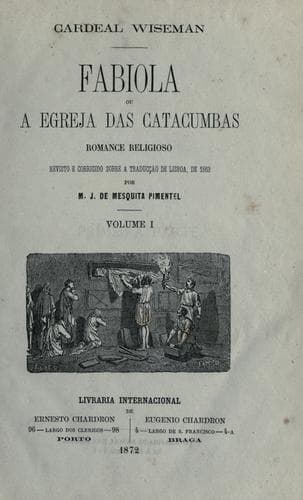
Fabiola; Or, The Church of the CatacombsWiseman, Nicholas Patrick
HistoryHistory
Fabiola; Or, The Church of the Catacombs
Wiseman, Nicholas Patrick
Christian fiction; Church history -- Primitive and early church, ca. 30-600 -- Fiction; Historical fiction
Her conversations with her slave, after the memorable one which we have
recounted, had satisfied her that she had received a superior education.
She was too delicate to question her on her early history; especially as
masters often had young slaves highly educated, to enhance their value.
But she soon discovered that she read Greek and Latin authors with ease
and elegance, and wrote well in both languages. By degrees she raised
her position, to the great annoyance of her companions: she ordered
Euphrosyne to give her a separate room, the greatest of comforts to the
poor maid; and she employed her near herself as a secretary and reader.
Still she could perceive no change in her conduct, no pride, no
pretensions; for the moment any work presented itself of the menial
character formerly allotted to her, she never seemed to think of turning
it over to any one else, but at once naturally and cheerfully set
herself about it.
The reading generally pursued by Fabiola was, as has been previously
observed, of rather an abstruse and refined character, consisting of
philosophical literature. She was surprised, however, to find how her
slave, by a simple remark, would often confute an apparently solid
maxim, bring down a grand flight of virtuous declamation, or suggest a
higher view of moral truth, or a more practical course of action, than
authors whom she had long admired proposed in their writings. Nor was
this done by any apparent shrewdness of judgment or pungency of wit; nor
did it seem to come from much reading, or deep thought, or superiority
of education. For though she saw traces of this in Syra’s words, ideas,
and behavior, yet the books and doctrines which she was reading now,
were evidently new to her. But there seemed to be in her maid’s mind
some latent but infallible standard of truth, some master-key, which
opened equally every closed deposit of moral knowledge, some
well-attuned chord, which vibrated in unfailing unison with what was
just and right, but jangled in dissonance with whatever was wrong,
vicious, or even inaccurate. What this secret was, she wanted to
discover; it was more like an intuition than any thing she had before
witnessed. She was not yet in a condition to learn, that the meanest and
least in the Kingdom of Heaven (and what lower than a slave?) was
greater in spiritual wisdom, intellectual light, and heavenly
privileges, than even the Baptist Precursor.[63]
It was on a delicious morning in October, that, reclining by the spring,
the mistress and slave were occupied in reading; when the former,
wearied with the heaviness of the volume, looked for something lighter
and newer; and, drawing out a manuscript from her casket, said:
“Syra, put that stupid book down. Here is something, I am told, very
amusing, and only just come out. It will be new to both of us.”
Public-domain text, read in full here on John Shaqi.
Reviews
Reviews
No reviews yet
Be the first to share your thoughts on this work.
Elsewhere in the archive
Join the Discussion
Join the discussion
Sign in to leave a comment or review.
Sign InorCreate an account