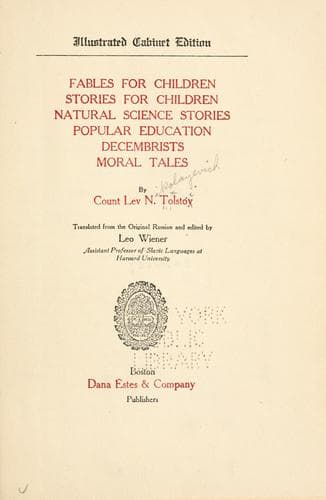
Fables for Children, Stories for Children, Natural Science Stories, Popular Education, Decembrists, Moral TalesTolstoy, Leo, graf
General
Fables for Children, Stories for Children, Natural Science Stories, Popular Education, Decembrists, Moral Tales
Tolstoy, Leo, graf
Russian literature -- Translations into English
The officer of Cossacks unfolded the paper and read the name of him who
once had been Prince Peter Ivánovich, and the family name which
everybody knows and pronounces with a certain respect and pleasure, when
speaking of a person bearing that name, as of a near and familiar
person. We shall call him Labázov. The officer of Cossacks had a dim
recollection that this Peter Labázov had been something important in the
year '25, and that he had been sent to hard labour,--but what he had
been famous for, he did not exactly know. But of the others not one knew
anything about him, and they replied:
"Oh, yes, the famous prince," just as they would have said, "Of course,
he is famous!" about Shakespeare, who had written the "Æneid." But they
recognized him from the explanations of the stout officer, who told
them that he was a brother of Prince Iván, an uncle of the Chíkins, of
Countess Prut, in short, the well-known--
"He must be very rich, if he is a brother of Prince Iván," remarked one
of the young men, "if the fortune has been returned to him. It has been
returned to some."
"What a lot of exiles are returning nowadays!" remarked another.
"Really, fewer seem to have been sent away, than are returning now.
Zhikínski, tell us that story of the 18th!" he turned to an officer of
sharp-shooters, who had the reputation of being a good story-teller.
"Do tell it!"
"In the first place, it is a true story, and happened here, at
Chevalier's, in the large hall. Three Decembrists came to have their
dinner. They were sitting at one table, eating, drinking, talking.
Opposite them sat down a gentleman of respectable mien, of about the
same age, and he listened to their talking about Siberia. He asked them
something, they exchanged a few words, began to converse, and it turned
out that he, too, was from Siberia.
"'And do you know Nerchínsk?'
"'Indeed I do, I lived there.'
"'And do you know Tatyána Ivánovna?'
"'Of course I do!'
"'Permit me to ask you,--were you, too, exiled?'
"'Yes, I had the misfortune to suffer, and you?'
"'We are all exiles of the 14th of December. It is strange that we
should not know you, if you, too, were exiled for the 14th. Permit me to
know your name!'
"'Fédorov.'
"'Also for the 14th?'
"'No, for the 18th.'
"'For the 18th?'
"'For the 18th of September, for a gold watch. I was falsely accused of
having stolen it, and I suffered, though innocent.'"
All of them rolled in laughter, except the story-teller, who with a most
serious face looked at the outstretched hearers and swore that it was a
true story.
Public-domain text, read in full here on John Shaqi.
Reviews
Reviews
No reviews yet
Be the first to share your thoughts on this work.
Elsewhere in the archive
Join the Discussion
Join the discussion
Sign in to leave a comment or review.
Sign InorCreate an account