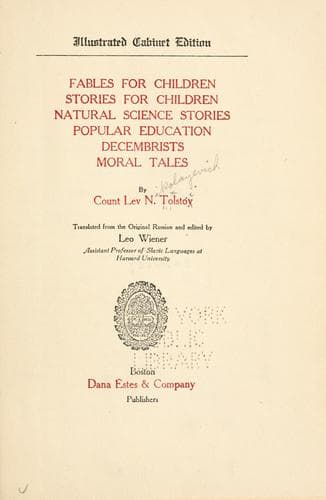
Fables for Children, Stories for Children, Natural Science Stories, Popular Education, Decembrists, Moral TalesTolstoy, Leo, graf
General
Fables for Children, Stories for Children, Natural Science Stories, Popular Education, Decembrists, Moral Tales
Tolstoy, Leo, graf
Russian literature -- Translations into English
Soon after the story one of the young men got up and went to the club.
He passed through the halls which were filled with tables at which old
men were playing whist; turned into the "infernal region," where the
famous "Puchin" had begun his game against the "company;" stood for
awhile near one of the billiard-tables, where, holding on to the
cushion, a distinguished old man was fumbling around and with difficulty
striking a ball; looked into the library, where a general, holding a
newspaper a distance away from him, was reading it slowly above his
glasses, and a registered young man turned the leaves of one periodical
after another, trying to make no noise; and finally seated himself on a
divan in the billiard-room, near some young people who were playing
pyramids, and who were as much gilded as he was.
It was a day of dinners, and there were there many gentlemen who always
frequented the club. Among them was Iván Vavílovich Pákhtin. He was a
man of about forty years of age, of medium stature, fair-complexioned,
with broad shoulders and hips, with a bare head, and a glossy, happy,
clean-shaven face. He was not playing at pyramids, but had just sat down
beside Prince D----, with whom he was on "thou" terms, and had accepted
a glass of champagne which had been offered to him. He had located
himself so comfortably after the dinner, having quietly unbuckled his
trousers at the back, that it looked as though he could sit there all
his life, smoking a cigar, drinking champagne, and feeling the proximity
of princes, counts, and the children of ministers. The news of the
arrival of the Labázovs interfered with his calm.
"Where are you going, Pákhtin," said a minister's son, having noticed
during the game that Pákhtin had got up, pulled his waistcoat down, and
emptied his champagne in a large gulp.
"Syévernikov has invited me," said Pákhtin, feeling a restlessness in
his legs. "Well, will you go there?"
"Anastásya, Anastásya, please unlock the door for me." That was a
well-known gipsy-song, which was in vogue at that time.
"Perhaps. And you?"
"Where shall I, an old married man, go?"
"Well!"
Pákhtin, smiling, went to the glass hall, to join Syévernikov. He was
fond of having his last word appear to be a joke. And so it came out at
that time, too.
"Well, how is the countess's health?" he asked, walking over to
Syévernikov, who had not called him at all, but who, according to
Pákhtin's surmise, should more than any one else learn of the arrival of
the Labázovs. Syévernikov had somehow been mixed up with the affair of
the 14th, and was a friend of the Decembrists. The countess's health was
much better, and Pákhtin was very glad to hear it.
"Do you know, Labázov has arrived; he is staying at Chevalier's."
"You don't say so! We are old friends. How glad I am! How glad! The poor
old fellow must have grown old. His wife wrote to my wife--"
Public-domain text, read in full here on John Shaqi.
Reviews
Reviews
No reviews yet
Be the first to share your thoughts on this work.
Elsewhere in the archive
Join the Discussion
Join the discussion
Sign in to leave a comment or review.
Sign InorCreate an account