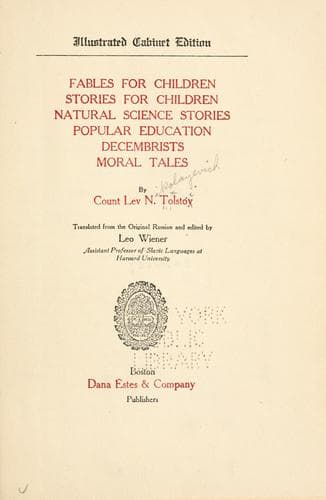
Fables for Children, Stories for Children, Natural Science Stories, Popular Education, Decembrists, Moral TalesTolstoy, Leo, graf
General
Fables for Children, Stories for Children, Natural Science Stories, Popular Education, Decembrists, Moral Tales
Tolstoy, Leo, graf
Russian literature -- Translations into English
This statement vexed Iván Pávlovich, and again he was at a loss whether
there was any cause for rejoicing at Labázov's return, and, in order
fully to settle his doubt, he directed his steps to a room, where
generally assembled the clever people, who knew the meaning and value of
each thing, and, in short, knew everything. Iván Pávlovich was on the
same footing of friendship with the frequenters of the intellectual room
as with the gilded youths and with the dignitaries. It is true, he had
no special place of his own in the intellectual room, but nobody was
surprised to see him enter and seat himself on a divan. They were just
discussing in what year and upon what occasion there had taken place a
quarrel between two Russian journalists. Waiting for a moment of
silence, Iván Pávlovich communicated his bit of news, not as something
joyous, nor as an unimportant event, but as though part of the
conversation. But immediately, from the way the "intellectuals" (I use
the word "intellectuals" as a name for the frequenters of the
"intellectual" room) received the news and began to discuss it, Iván
Pávlovich understood that it belonged there, and that only there would
it receive such an elaboration as to enable him to carry it farther and
_savoir à quoi s'en tenir_.
"Labázov was the only one who was wanting," said one of the
intellectuals; "now all the living Decembrists have returned to Russia."
"He was one of the herd of the famous--" said Pákhtin, still with an
inquisitive glance, prepared to make that quotation both jocular and
serious.
"Indeed, Labázov was one of the most remarkable men of that time," began
an intellectual. "In 1819 he was an ensign of the Seménovski regiment,
and was sent abroad with messages to Duke Z----. Then he returned and in
the year '24 was received in the First Masonic lodge. The Masons of that
time used all to gather at the house of D---- and at his house. He was
very rich. Prince Zh----, Fédor D----, Iván P----, those were his
nearest friends. Then his uncle, Prince Visarión, to remove the young
man from that society, took him to Moscow."
"Pardon me, Nikoláy Stepánovich," another intellectual interrupted him,
"it seems to me that that happened in the year '23, because Visarión
Labázov was appointed a commander of the Third Corps in '24, and was
then in Warsaw. He had offered him an adjutantship, and after his
refusal, he was removed. However, pardon me for interrupting you."
"Not at all. Proceed!"
"Pardon me!"
"Proceed! You ought to know that better than I, and, besides, your
memory and knowledge have been sufficiently attested here."
Public-domain text, read in full here on John Shaqi.
Reviews
Reviews
No reviews yet
Be the first to share your thoughts on this work.
Elsewhere in the archive
Join the Discussion
Join the discussion
Sign in to leave a comment or review.
Sign InorCreate an account