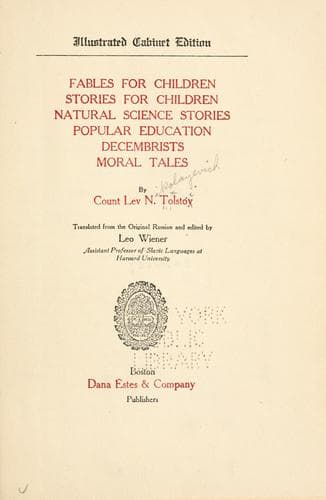
Fables for Children, Stories for Children, Natural Science Stories, Popular Education, Decembrists, Moral TalesTolstoy, Leo, graf
General
Fables for Children, Stories for Children, Natural Science Stories, Popular Education, Decembrists, Moral Tales
Tolstoy, Leo, graf
Russian literature -- Translations into English
"In Moscow he against his uncle's will left the army," continued the one
whose memory and knowledge had been attested, "and there he gathered
around him a second society, of which he was the progenitor and the
heart, if it be possible so to express it. He was rich, handsome,
clever, educated; they say he was exceedingly amiable. My aunt used to
tell me that she did not know a more bewitching man. Here he married
Miss Krínski, a few months before the revolt broke out."
"The daughter of Nikoláy Krínski, the one of Borodinó fame, you know,"
somebody interrupted him.
"Well, yes. Her immense fortune he still possesses, but his own paternal
estate passed over to his younger brother, Prince Iván, who is now
Ober-Hof-Kaffermeister" (he gave him some such name) "and was a
minister."
"The best thing is what he did for his brother," continued the narrator.
"When he was arrested, there was one thing which he succeeded in
destroying, and that was his brother's letters and documents."
"Was his brother mixed up in it, too?"
The narrator did not say "Yes," but compressed his lips and gave a
significant wink.
"Then, during all the inquests Peter Labázov kept denying everything
which concerned his brother, and so suffered more than the rest. But the
best part of it is that Prince Iván got all the property, and never sent
a penny to his brother."
"They say that Peter Labázov himself declined it," remarked one of the
hearers.
"Yes; but he declined it only because Prince Iván wrote him before the
coronation, excusing himself and saying that if he had not taken it, it
would have been confiscated, and that he had children and debts, and
that now he was unable to return it to him. Peter Labázov replied to him
in two lines: 'Neither I nor my heirs have any right, nor can have any
right, to the property legally appropriated by you.' That was all. How
was that? And Prince Iván swallowed it, and in delight locked up that
document with the notes in a safe, and showed it to no one."
One of the peculiarities of the intellectual room was that its visitors
knew, whenever they wanted to know, everything that was taking place in
the world, no matter how secret the event might have been.
"Still it is a question," said a new interlocutor, "whether it was just
to deprive the children of Prince Iván of the property, with which they
have grown up and have been educated, and to which they thought they had
a right."
Thus the conversation was transferred to an abstract sphere, which did
not interest Pákhtin.
He felt the necessity of communicating the news to fresh people, and so
he rose and, speaking to the right and to the left, walked from one hall
to another. One of his fellow officers stopped him to give him the news
of Labázov's arrival.
"Who does not know that?" replied Iván Pávlovich, with a calm smile,
turning to the exit. The news had had time to complete its circle, and
was again returning to him.
Public-domain text, read in full here on John Shaqi.
Reviews
Reviews
No reviews yet
Be the first to share your thoughts on this work.
Elsewhere in the archive
Join the Discussion
Join the discussion
Sign in to leave a comment or review.
Sign InorCreate an account