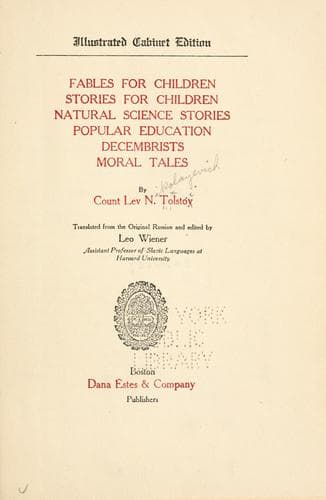
Fables for Children, Stories for Children, Natural Science Stories, Popular Education, Decembrists, Moral TalesTolstoy, Leo, graf
General
Fables for Children, Stories for Children, Natural Science Stories, Popular Education, Decembrists, Moral Tales
Tolstoy, Leo, graf
Russian literature -- Translations into English
There was nothing else to do in the club, and he went to an evening
party. It was not a special entertainment, but a salon where guests were
received any evening. There were there eight ladies, and one old
colonel, and all found it terribly dull. Pákhtin's firm gait alone and
his smiling face cheered the ladies and maidens. And the news was the
more appropriate, since the old Countess Fuks and her daughter were
present in the salon. When Pákhtin told nearly word for word what he had
heard in the intellectual room, Madame Fuks, shaking her head and
marvelling at her old age, began to recall how she used to go out
together with Natásha Krínski, the present Princess Labázov.
"Her marriage is a very romantic story, and all that happened under my
eyes. Natásha was almost engaged to Myátlin, who was later killed in a
duel with Debras. Just then Prince Peter arrived in Moscow, fell in love
with her, and proposed to her. But her father, who wanted Myátlin very
much,--they were, in general, afraid of Labázov because he was a
Mason,--refused him. The young man continued to see her at balls,
everywhere, and became friendly with Myátlin, whom he begged to decline.
Myátlin agreed to do so, and he persuaded her to elope. She, too,
agreed, but the last repentance----" (the conversation was taking place
in French), "and she went to her father and said that everything was
ready for the elopement, and she could leave him, but hoped for his
magnanimity. And, indeed, her father forgave her,--everybody begged for
her,--and gave his consent. Thus the wedding was celebrated, and it was
a jolly wedding! Who of us thought that a year later she would follow
him to Siberia! She, an only daughter, the most beautiful, the richest
woman of that time. Emperor Alexander always used to notice her at
balls, and had danced with her so often. Countess G---- gave a _bal
costumé_,--I remember it as though it were to-day,--and she was a
Neapolitan maid, oh, so charming! Whenever he came to Moscow, he used to
ask, '_que fait la belle Napolitaine_?' And suddenly this woman, in such
a condition (she bore a child on the way), did not stop for a moment to
think, without preparing anything, without collecting her things, just
as she was, when they took him, followed him a distance of five thousand
versts."
"Oh, what a remarkable woman!" said the hostess.
"Both he and she were remarkable people," said another lady. "I have
been told,--I don't know whether it is true,--that wherever they worked
in the mines in Siberia, or whatever it is called, the convicts, who
were with them, improved in their presence."
"But she has never worked in the mines," Pákhtin corrected her.
Public-domain text, read in full here on John Shaqi.
Reviews
Reviews
No reviews yet
Be the first to share your thoughts on this work.
Elsewhere in the archive
Join the Discussion
Join the discussion
Sign in to leave a comment or review.
Sign InorCreate an account