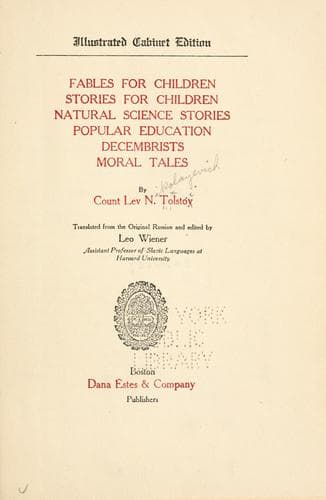
Fables for Children, Stories for Children, Natural Science Stories, Popular Education, Decembrists, Moral TalesTolstoy, Leo, graf
General
Fables for Children, Stories for Children, Natural Science Stories, Popular Education, Decembrists, Moral Tales
Tolstoy, Leo, graf
Russian literature -- Translations into English
The winning of this irregular case by the peasants surprised all the
neighbours and even the peasants themselves. This success of theirs
could be explained only on the supposition that Iván Petróvich Apýkhtin,
a very meek, peaceful man, who was opposed to litigations and was
convinced of the righteousness of this matter, had taken no measures
against the action of the peasants. On the other hand, Iván Mirónov, the
peasants' representative, a dry, hook-nosed, literate peasant, who had
been a township elder and had acted in the capacity of collector of
taxes, had collected fifty kopeks from each peasant, which money he
cleverly applied in the distribution of presents, and had very shrewdly
conducted the whole affair.
Immediately after the decision handed down by the County Court,
Apýkhtin, seeing the danger, gave a power of attorney to the shrewd
manumitted serf, Ilyá Mitrofánov, who appealed to the higher court
against the decision of the County Court. Ilyá Mitrofánov managed the
affair so shrewdly that, in spite of all the cunning of the peasants'
representative, Iván Mirónov, in spite of the considerable presents
distributed by him to the members of the higher court, the case was
retried in the Government Court in favour of the proprietor, and the
land was to go back to him from the peasants, of which fact their
representative was duly informed.
The representative, Iván Mirónov, told the peasants at the meeting of
the Commune that the gentleman in the Government capital had pulled the
proprietor's leg and had "mixed up" the whole business, so that they
wanted to take the land back again, but that the proprietor would not be
successful, because he had a petition all written up to be sent to the
Senate, and that then the land would be for ever confirmed to the
peasants; all they had to do was to collect a rouble from each soul. The
peasants decided to collect the money and again to entrust the whole
matter to Iván Mirónov. When Mirónov had all the money in his hands, he
went to St. Petersburg.
When, in the year 1817, during Passion-week,--it fell late that
year,--the time came to plough the ground, the Izlegóshcha peasants
began to discuss at a meeting whether they ought to plough the land
under litigation during that year, or not; and, although Apýkhtin's
clerk had come to see them during Lent with the order that they should
not plough the land and should come to some agreement with him in regard
to the rye already planted in what had been the doubtful, and now was
Apýkhtin's land, the peasants, for the very reason that the winter crop
had been sowed on the debatable land, and because Apýkhtin, in his
desire to avoid being unfair to them, wished to arbitrate the matter
with them, decided to plough the land under litigation and to take
possession of it before touching any other fields.
Public-domain text, read in full here on John Shaqi.
Reviews
Reviews
No reviews yet
Be the first to share your thoughts on this work.
Elsewhere in the archive
Join the Discussion
Join the discussion
Sign in to leave a comment or review.
Sign InorCreate an account