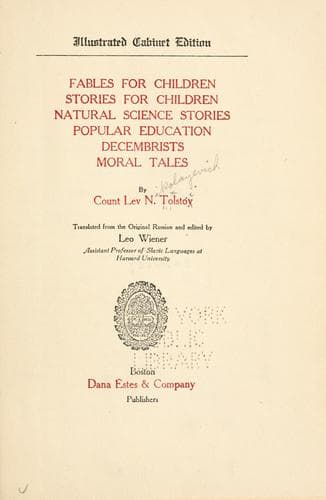
Fables for Children, Stories for Children, Natural Science Stories, Popular Education, Decembrists, Moral TalesTolstoy, Leo, graf
General
Fables for Children, Stories for Children, Natural Science Stories, Popular Education, Decembrists, Moral Tales
Tolstoy, Leo, graf
Russian literature -- Translations into English
On the very day when the peasants went out to plough, which was Maundy
Thursday, Iván Petróvich Apýkhtin, who had been preparing himself for
communion during the Passion-week, went to communion, and early in the
morning drove to the church in the village of Izlegóshcha, of which he
was a parishioner, and there he, without knowing anything about the
matter, amicably chatted with the church elder. Iván Petróvich had been
to confession the night before, and had attended vigils at home; in the
morning he had himself read the Rules, and at eight o'clock had left the
house. They waited for him with the mass. As he stood at the altar,
where he usually stood, Iván Petróvich rather reflected than prayed,
which made him dissatisfied with himself.
Like many people of that time, and, so far as that goes, of all times,
he was not quite clear in matters of religion. He was past fifty years
of age; he never omitted carrying out any rite, attended church, and
went to communion once a year; in talking to his only daughter, he
instructed her in the articles of faith; but, if he had been asked
whether he really believed, he would not have known what to reply.
On that day more than on any other, he felt meek of spirit, and,
standing at the altar, he, instead of praying, thought of how strangely
everything was constructed in the world: there he was, almost an old
man, taking the communion for perhaps the fortieth time in his life, and
he knew that everybody, all his home folk and all the people in the
church, looked at him as a model and took him for an example, and he
felt himself obliged to act as an example in matters of religion,
whereas he himself did not know anything, and soon, very soon, he would
die, and even if he were killed he could not tell whether that in which
he was showing an example to others was true. And it also seemed strange
to him how every one considered--that he saw--old people to be firm and
to know what was necessary and what not (thus he always thought about
old men), and there he was old and positively failed to know, and was
just as frivolous as he had been twenty years before; the only
difference was that formerly he did not conceal it, while now he did.
Just as in his childhood it had occurred to him during the service that
he might crow like a cock, even so now all kinds of foolish things
passed through his mind, and he, the old man, reverentially bent his
head, touching the flagstones of the church with the old knuckles of his
hands, and Father Vasíli was evidently timid in celebrating mass in his
presence, and incited to zeal by his zeal.
"If they only knew what foolish things are running through my head! But
that is a sin, a sin; I must pray," he said to himself, when the service
commenced; and, trying to catch the meaning of the responses, he began
to pray. Indeed, he soon transferred himself in feeling to the prayer
and thought of his sins and of everything which he regretted.
Public-domain text, read in full here on John Shaqi.
Reviews
Reviews
No reviews yet
Be the first to share your thoughts on this work.
Elsewhere in the archive
Join the Discussion
Join the discussion
Sign in to leave a comment or review.
Sign InorCreate an account