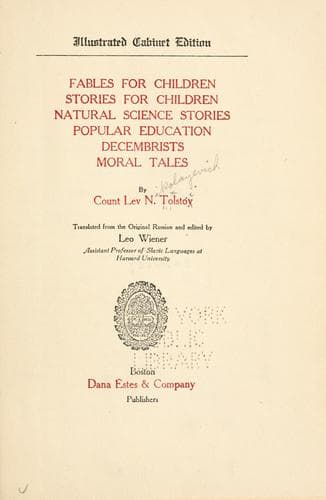
Fables for Children, Stories for Children, Natural Science Stories, Popular Education, Decembrists, Moral TalesTolstoy, Leo, graf
General
Fables for Children, Stories for Children, Natural Science Stories, Popular Education, Decembrists, Moral Tales
Tolstoy, Leo, graf
Russian literature -- Translations into English
The only ones of those concerned in the case who could not forget it
were the six peasants who were passing their seventh month in jail, and
their families that were left without their heads. But nothing could be
done in the matter. They were imprisoned in Krasnoslobódsk, and their
families tried to get along as well as they could. Nobody could be
invoked in the case. Iván Mirónovich himself said that he could not take
it up, because it was not a communal, nor a civil, but a criminal case.
The peasants were in prison, and nobody paid any attention to them; but
one family, that of Mikhaíl Gerásimovich, particularly his wife
Tíkhonovna, could not get used to the idea that the precious old man,
Gerásimovich, was sitting in prison with a shaven head. Tíkhonovna could
not rest quiet. She begged Mirónovich to take the case, but he declined
it. Then she decided to go herself to pray to God for the old man. She
had made a vow the year before that she would go on a pilgrimage to a
saint, and had delayed it for another year only because she had had no
time and did not wish to leave the house to the young daughters-in-law.
Now that the misfortune had happened and Gerásimovich was put into jail,
she recalled her vow; she turned her back on her house and, together
with the deacon's wife of the same village, got ready to go on the
pilgrimage.
First they went to the county seat to see her old man in the prison and
to take him some shirts; from there they went through the capital of the
Government to Moscow. On her way Tíkhonovna told the deacon's wife of
her sorrow, and the latter advised her to petition the emperor who, it
was said, was to be in Pénza, telling her of various cases of pardon
granted by him.
When the pilgrims arrived in Pénza, they heard that there was there, not
the emperor, but his brother Grand Duke Nikoláy Pávlovich. When he came
out of the cathedral, Tíkhonovna pushed herself forward, dropped down on
her knees, and began to beg for her husband. The grand duke was
surprised, the governor was angry, and the old woman was taken to the
lockup. The next day she was let out and she proceeded to Tróitsa. In
Tróitsa she went to communion and confessed to Father Paísi. At the
confession she told him of her sorrow, and repented having petitioned
the brother of the Tsar. Father Paísi told her that there was no sin in
that and that there was no sin in petitioning the Tsar even in a just
case, and dismissed her. In Khótkov she called on the blessed abbess,
and she ordered her to petition the Tsar himself.
On their way back, Tíkhonovna and the deacon's wife stopped in Moscow to
see the saints. Here she heard that the Tsar was there, and she thought
that it was evidently God's command that she should petition the Tsar.
All that had to be done was to write the petition.
Public-domain text, read in full here on John Shaqi.
Reviews
Reviews
No reviews yet
Be the first to share your thoughts on this work.
Elsewhere in the archive
Join the Discussion
Join the discussion
Sign in to leave a comment or review.
Sign InorCreate an account