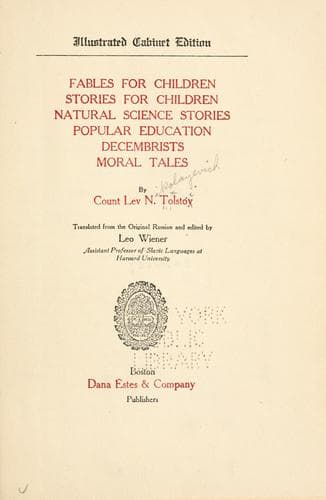
Fables for Children, Stories for Children, Natural Science Stories, Popular Education, Decembrists, Moral TalesTolstoy, Leo, graf
General
Fables for Children, Stories for Children, Natural Science Stories, Popular Education, Decembrists, Moral Tales
Tolstoy, Leo, graf
Russian literature -- Translations into English
"Do you not recognize us, dear man? Is not your name Egór?" asked the
deacon's wife. "We are coming back from the saints, and so are calling
on her Serenity."
"You are from Izlegóshcha," said the janitor. "You are the wife of the
old deacon,--of course. All right, all right. Go to the house! Everybody
is received here,--nobody is refused. And who is this one?"
He pointed to Tíkhonovna.
"From Izlegóshcha, Gerásimovich's wife,--used to be Fadyéev's,--I
suppose you know her?" said Tíkhonovna. "I myself am from Izlegóshcha."
"Of course! They say your husband has been put into jail."
Tíkhonovna made no reply; she only sighed and with a strong motion threw
her wallet and fur coat over her shoulder.
The deacon's wife asked whether the old lady was at home and, hearing
that she was, asked him to announce them to her. Then she asked about
her son, who was an official and, thanks to the prince's influence, was
serving in St. Petersburg. The janitor could not give her any
information about him and directed them over a walk, which crossed the
yard, to the servants' house. The old women went into the house, which
was full of people,--women, children, both old and young,--all of them
manorial servants, and prayed turning to the front corner. The deacon's
wife was at once recognized by the laundress and the old lady's maid,
and she was at once surrounded and overwhelmed with questions: they took
off her wallet, placed her at the table, and offered her something to
eat. In the meantime Tíkhonovna, having made the sign of the cross to
the images and saluted everybody, was standing at the door, waiting to
be invited in. At the very door, in front of the first window, sat an
old man, making boots.
"Sit down, granny! Don't stand up. Sit down here, and take off your
wallet," he said.
"There is not enough room to turn around as it is. Take her to the
'black' room," said a woman.
"This comes straight from Madame Chalmé," said a young lackey, pointing
to the iris design on Tíkhonovna's peasant coat, "and the pretty
stockings and shoes."
He pointed to her leg-rags and bast shoes, which were new, as she had
specially put them on for Moscow.
"Parásha, you ought to have such."
"If you are to go to the 'black' room, all right; I will take you
there." And the old man stuck in his awl and got up; but, on seeing a
little girl, he called her to take the old woman to the black room.
Tíkhonovna not only paid no attention to what was being said in her
presence and of her, but did not even look or listen. From the time that
she entered the house, she was permeated with the feeling of the
necessity of working for God and with the other feeling, which had
entered her soul, she did not know when, of the necessity of handing the
petition. Leaving the clean servant room, she walked over to the
deacon's wife and, bowing, said to her:
"Mother Paramónovna, for Christ's sake do not forget about my affair!
See whether you can't find a man."
"What does that woman need?"
Public-domain text, read in full here on John Shaqi.
Reviews
Reviews
No reviews yet
Be the first to share your thoughts on this work.
Elsewhere in the archive
Join the Discussion
Join the discussion
Sign in to leave a comment or review.
Sign InorCreate an account