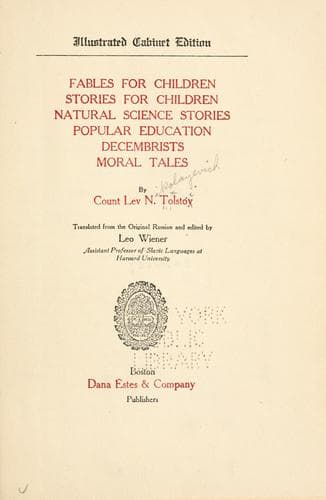
Fables for Children, Stories for Children, Natural Science Stories, Popular Education, Decembrists, Moral TalesTolstoy, Leo, graf
General
Fables for Children, Stories for Children, Natural Science Stories, Popular Education, Decembrists, Moral Tales
Tolstoy, Leo, graf
Russian literature -- Translations into English
Tíkhonovna sat down on the bench, having taken off her coat and
carefully folded it, and began to take off her footgear. At first she
untied the laces, which she had taken special care in twisting smooth
for her pilgrimage; then she carefully unwrapped the white lambskin
leg-rags and, carefully rubbing them soft, placed them on her wallet.
Just as she was working on her other foot, another of awkward Marína's
pots got caught and spilled over, and she again started to scold
somebody, catching the pot with the fork.
"The hearth is evidently burned out, grandfather. It ought to be
plastered," said Tíkhonovna.
"When are you going to plaster it? The chimney never cools off: twice a
day you have to bake bread; one set is taken out, and the other is
started."
In response to Marína's complaint about the bread-baking and the
burnt-out hearth, the tailor defended the ways of the Chernýshev house
and said that they had suddenly arrived in Moscow, that the hut was
built and the oven put up in three weeks, and that there were nearly one
hundred servants who had to be fed.
"Of course, lots of cares. A large establishment," Tíkhonovna confirmed
him.
"Whence does God bring you?" the tailor turned to her.
And Tíkhonovna, continuing to take off her foot-gear, at once told him
where she came from, whither she had gone, and how she was going home.
She did not say anything about the petition. The conversation never
broke off. The tailor found out everything about the old woman, and the
old woman heard all about awkward, pretty Marína. She learned that
Marína's husband was a soldier, and she was made a cook; that the tailor
was making caftans for the driving coachmen; that the stewardess's
errand girl was an orphan, and that shaggy-haired, gloomy Pankrát was a
servant of the clerk, Iván Vasílevich.
Pankrát left the room, slamming the door. The tailor told her that he
was a gruff peasant, but that on that day he was particularly rude
because the day before he had smashed the clerk's knickknacks on the
window, and that he was going to be flogged to-day in the stable. As
soon as Iván Vasílevich should come, he would be flogged. The little
coachman was a peasant lad, who had been made an outrider, and now that
he was grown he had nothing to do but attend to the horses, and strum
the balaláyka. But he was not much of a hand at it.
ON POPULAR EDUCATION
1875
ON POPULAR EDUCATION
Public-domain text, read in full here on John Shaqi.
Reviews
Reviews
No reviews yet
Be the first to share your thoughts on this work.
Elsewhere in the archive
Join the Discussion
Join the discussion
Sign in to leave a comment or review.
Sign InorCreate an account