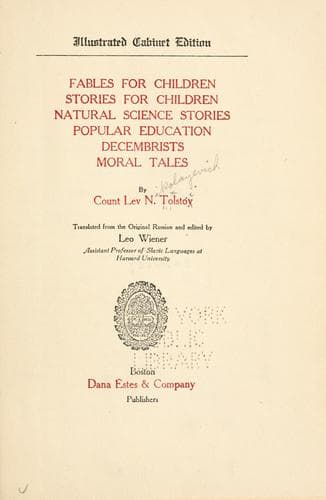
Fables for Children, Stories for Children, Natural Science Stories, Popular Education, Decembrists, Moral TalesTolstoy, Leo, graf
General
Fables for Children, Stories for Children, Natural Science Stories, Popular Education, Decembrists, Moral Tales
Tolstoy, Leo, graf
Russian literature -- Translations into English
"No, an opinion about the method of construction based on such
near-sighted and flimsy foundations (that is, on experience) will be too
doubtful. Only the theoretical substratum, based on the study of human
nature, can make the judgments in this sphere firm and independent of
all casualties, and to a considerable degree guard them against gross
errors. Consequently for the final choice of the best method of teaching
the rudiments, it is necessary first of all to stand on theoretic soil,
on the basis of previous considerations, the general conditions of which
give to this or that method the actual right to be called satisfactory
from the pedagogical standpoint. These conditions are: (1) It has to be
a method which is capable of developing the child's mental powers, so
that the acquisition of the rudiments may be obtained together with the
development and the strengthening of the reasoning powers. (2) It must
introduce into the instruction the child's personal interest, so that
the matter be furthered by this interest, and not by dulling violence.
(3) It must represent in itself the process of self-instruction,
inciting, supporting, and directing the child's self-activity. (4) It
must be based on the impressions of hearing, as of the sense which
serves for the acquisition of language. (5) It has to combine analysis
with synthesis, beginning with the dismemberment of the complex whole
into simple principles, and passing over to the composition of a complex
whole out of the simple principles."
So this is what the method of instruction is to be based upon. I will
remark, not for contradiction, but for the sake of simplicity and
clearness, that the last two statements are quite superfluous, because
without the union of analysis and synthesis there can be not only no
instruction, but also no other activity of the mind, and every
instruction, except that of the deaf and dumb, is based on the sense of
hearing. These two conditions are put down only for beauty's sake and
for the obscuration of the style, so common in pedagogical treatises,
and so have no meaning whatever. The first three at first sight appear
quite true as a programme. Everybody, of course, would like to know how
the method is secured that will "develop," that will "introduce into the
instruction the pupil's personal interest," and that will "represent the
process of self-instruction."
Public-domain text, read in full here on John Shaqi.
Reviews
Reviews
No reviews yet
Be the first to share your thoughts on this work.
Elsewhere in the archive
Join the Discussion
Join the discussion
Sign in to leave a comment or review.
Sign InorCreate an account