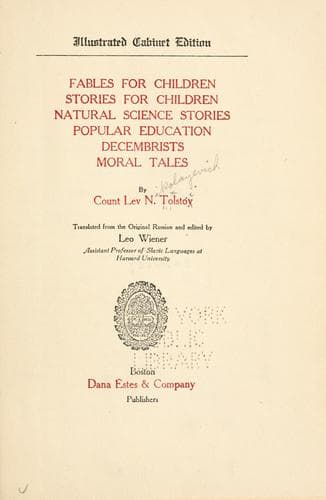
Fables for Children, Stories for Children, Natural Science Stories, Popular Education, Decembrists, Moral TalesTolstoy, Leo, graf
General
Fables for Children, Stories for Children, Natural Science Stories, Popular Education, Decembrists, Moral Tales
Tolstoy, Leo, graf
Russian literature -- Translations into English
But to the questions as to why this method combines all those qualities
you will find an answer neither in the books of Messrs. Bunákov and
Evtushévski, nor in any other pedagogical work of the founders of this
school of pedagogy, unless they be those hazy discussions of this
nature, such as that every instruction must be based on the union of
analysis and synthesis, and by all means on the sense of hearing, and so
forth; or you will find, as in Mr. Evtushévski's book, expositions about
how in man are formed impressions, sensations, representations, and
concepts, and you will find the rule that "it is necessary to start from
the object and lead the pupil up to the idea, and not start with the
idea, which has no point of contact in his consciousness," and so forth.
After such discussions there always follows the conclusion that
therefore the method advocated by the pedagogue gives that exclusive
real development which it was necessary to find.
After the above-cited definition of what a good method ought to be, Mr.
Bunákov explains how children ought to be educated, and, having given an
exposition of all the methods, which in my opinion and experience lead
to results which are diametrically opposite to development, he says
frankly and definitely:
"From the standpoint of the above-mentioned fundamental principles for
estimating the value of the satisfactoriness of the methods of
rudimentary instruction, the method which we have just elucidated in its
general features presents the following plastic qualities and
peculiarities: (1) As a sound method it wholly preserves the
characteristic peculiarities of all sound method,--it starts from the
impressions of hearing, at once establishing the regular relation to
language, and only later adds to them the impressions of sight, thus
clearly distinguishing sound, matter, and the letter, its
representation. (2) As a method which unites reading with writing it
begins with decomposition and passes over to composition, combining
analysis with synthesis. (3) As a method which passes over to the study
of words and sounds from the study of objects it proceeds along a
natural path, coöperates with the regular formation of concepts and
ideas, and acts in a developing way on all the sides of the child's
nature: it incites the children to be observant, to group their
observations, to render them orally; it develops the external senses,
mind, imagination, memory, the gift of speech, concentration,
self-activity, the habit of work, the respect for order. (4) As a method
which provides ample work to all the mental powers of the child, it
introduces into instruction the personal interest, rousing in children
willingness and love of work, and transforming it into a process of
self-instruction."
Public-domain text, read in full here on John Shaqi.
Reviews
Reviews
No reviews yet
Be the first to share your thoughts on this work.
Elsewhere in the archive
Join the Discussion
Join the discussion
Sign in to leave a comment or review.
Sign InorCreate an account